In this 1919 essay, Sigmund Freud investigates the psychological nature of the 'uncanny' (das Unheimliche). He challenges the view that the uncanny is merely the 'novel' or 'unfamiliar,' arguing instead that it is a specific class of the terrifying that leads back to something long known and familiar that has been repressed. Freud analyzes E.T.A. Hoffmann's 'The Sand-Man' to demonstrate how themes of castration anxiety, the 'double,' and the omnipotence of thoughts evoke this feeling. He concludes that the uncanny arises either when repressed infantile complexes are revived by an impression, or when surmounted primitive beliefs appear to be confirmed by reality. The essay also explores how literature and fiction utilize these psychological mechanisms to create uncanny effects, often with more freedom than real-life experiences.
Transcription
The Uncanny (1919)
Sigmund Freud’s investigation into the nature of the "uncanny" (das Unheimliche).
Core Thesis
The uncanny is not merely the novel or unfamiliar.
It is a class of the terrifying that leads back to something long known and familiar that has been repressed.
The German word unheimlich is the opposite of heimlich (familiar, native, belonging to the home).
Key Themes
The Sand-Man:Freud uses this story to illustrate how the fear of losing one's eyes is a substitute for castration anxiety.
The Double: A creation dating back to an early mental stage; originally an assurance of immortality, it becomes a ghastly harbinger of death.
Omnipotence of Thoughts: The animistic belief that one's thoughts can directly influence reality, which can be re-activated in the adult mind.
Repetition-Compulsion: The involuntary recurrence of similar situations, which creates an uncanny atmosphere of something fateful and inescapable.
[c] Castration Anxiety: Fears regarding the eyes and blindness are often substitutes for the dread of castration.
Factors of the Uncanny
Repression: The uncanny is something familiar that has been estranged by the process of repression.
Surmounted Beliefs: When primitive beliefs (e.g., animism, magic) that we have supposedly outgrown seem to be confirmed by reality, we experience the uncanny.
Fiction vs. Reality: Fiction offers more opportunities to create uncanny effects than real life because it can manipulate the reader's reality-testing faculty.
Analysis of 'The Sand-Man'
Freud argues that the uncanny effect of the Sand-Man is directly attached to the fear of being robbed of one's eyes.
The doll Olympia represents a dissociated complex of the protagonist, Nathaniel, and his enslavement to this complex is expressed through his obsessive love.
The story illustrates the ambivalence of the father-imago, split into the threatening figure (Coppelius) and the loving father.
Fiction vs. Reality
Fiction provides more opportunities for creating uncanny effects than real life because it is not bound by reality-testing.
In literature, the uncanny can be evoked by overstepping the bounds of possibility after deceiving the reader into expecting a 'sober truth.'
When a story is set in an explicitly fantastic world (like fairy tales), the uncanny effect is often lost because the conflict of judgment regarding what is 'possible' is excluded from the start.
Summary of Notes & Topics
Page 1: Introduction to the subject of aesthetics and the definition of the uncanny as a province of the fearful.
Page 2: Linguistic analysis of unheimlich vs. heimlich. Jentsch's theory of intellectual uncertainty is deemed incomplete.
Page 3: Detailed breakdown of the various meanings of heimlich (homely, intimate, concealed, secret).
Page 4: The ambivalence of heimlich—it eventually coincides with its opposite, unheimlich.
Page 5-8: Analysis of Hoffmann's The Sand-Man. The doll Olympia and the fear of the Sand-Man are linked to the castration-complex and the father-imago.
Page 9-10: The theme of the "double" and its evolution from an insurance against death to a source of terror.
Page 11: Involuntary repetition as a source of the uncanny.
Page 12-13: The "omnipotence of thoughts" and the animistic conception of the universe.
Page 14: The uncanny nature of epilepsy, madness, and dismembered limbs.
Page 15-19: Discussion on the differences between the uncanny in real life versus literature and fiction.
Philosophical Foundations: The Aesthetics of the Uncanny
AI Summary?: The concept of the uncanny serves as a critical boundary in aesthetic theory. While traditional aesthetics focuses on the "beautiful" and the "sublime"—experiences categorized by positive, life-affirming, or transcendent emotions—the uncanny occupies a shadow space. It bridges the gap between the familiar and the unfamiliar. It is not merely "fear," but a specific psychological reaction to something that should be known or homey becoming strange, distorted, or threatening. This shift suggests that aesthetics cannot be limited to the study of beauty alone, as the negative, the eerie, and the disturbing are essential components of human psychological experience that demand rigorous analysis.
Quote from Epoch Philosophy:
“[Let’s not miss] the larger picture of emancipation in Fisher’s work(s)... Without the dismal understanding of the state of things, we have NO opportunity to explore the edge of it. The weird & the eerie and the possibilities that can bring emancipatory futures into existence... [perhaps] a new world is possible.”
Mark Fisher: he HEAVILY draws inspo from Freudian psychoanalytics
This is definitely a more optimistic view, which is a significant departure from the nihilism of cosmic horror
Epoch Philosophy’s Mark Fisher video:
[*] On the topic of repetition that evokes a sense of déjà vu, the unheimlich (the uncanny) exists at the edge of human experience, where the unknown starts to pervade... but it’s not JUST “the unknown.” It’s the unknown of the already repeat experiences (a.k.a. “the familiar”) that we already thought we understood (hence: uncanny).
Misc. Notes?
Mark Fisher
K-Punk (blog)
Good form notes
Process/essay
The Uncanny (Freud)
Critique/Notes
"The Uncanny" is the edge of aesthetics... but the reverse of that idea...
Philosophical Foundations: The Aesthetics of the Uncanny
AI Summary?: The concept of the uncanny serves as a critical boundary in aesthetic theory. While traditional aesthetics focuses on the "beautiful" and the "sublime"—experiences categorized by positive, life-affirming, or transcendent emotions—the uncanny occupies a shadow space. It bridges the gap between the familiar and the unfamiliar. It is not merely "fear," but a specific psychological reaction to something that should be known or homey becoming strange, distorted, or threatening. This shift suggests that aesthetics cannot be limited to the study of beauty alone, as the negative, the eerie, and the disturbing are essential components of human psychological experience that demand rigorous analysis.
Quote from Epoch Philosophy:
“[Let’s not miss] the larger picture of emancipation in Fisher’s work(s)... Without the dismal understanding of the state of things, we have NO opportunity to explore the edge of it. The weird & the eerie and the possibilities that can bring emancipatory futures into existence... [perhaps] a new world is possible.”
Mark Fisher: he HEAVILY draws inspo from Freudian psychoanalytics
This is definitely a more optimistic view, which is a significant departure from the nihilism of cosmic horror
Epoch Philosophy’s Mark Fisher video:
[*] On the topic of repetition that evokes a sense of déjà vu, the unheimlich (the uncanny) exists at the edge of human experience, where the unknown starts to pervade... but it’s not JUST “the unknown.” It’s the unknown of the already repeat experiences (a.k.a. “the familiar”) that we already thought we understood (hence: uncanny).
Misc. Notes?
Mark Fisher
K-Punk (blog)
Good form notes
Process/essay
The Uncanny (Freud)
Critique/Notes
"The Uncanny" is the edge of aesthetics... but the reverse of that idea...
The “Uncanny” (1919)
SIGMUND FREUD
I
It is only rarely that a psychoanalyst feels impelled to investigate the subject of aesthetics even when aesthetics is understood to mean not merely the theory of beauty, but the theory of the qualities of feeling. He works in other planes of mental life and has little to do with those subdued emotional activities which, inhibited in their aims and dependent upon a multitude of concurrent factors, usually furnish the material for the study of aesthetics. But it does occasionally happen that he has to interest himself in some particular province of that subject; and then it usually proves to be a rather remote region of it and one that has been neglected in standard works.
The subject of the“uncanny” is a province of this kind. It undoubtedly belongs to all that is terrible—to all that arousesdreadand creeping horror; it is equally certain, too, that the word is not always used in a clearly definable sense, so that it tends to coincide with whatever excites dread. Yet we may expect that it implies some intrinsic quality which justifies the use of a special name. One is curious to know what this peculiar quality is which allows us to distinguish as “uncanny” certain things within the boundaries of what is “fearful.”
My analysis: — Page 1
In my own words:
My annotations:
[*] undoubtedly belongs to all that is terrible—to all that arousesdreadand creeping horror
As good as nothing is to be found upon this subject in elaborate treatises on aesthetics, which in general prefer to concern themselves with what isbeautiful, attractiveandsublime, that is with feelings of a positive nature, with the circumstances and the objects that call them forth, rather than with theoppositefeelings ofunpleasantnessandrepulsion. I know of only one attempt in medico-psychological literature, a fertile but not exhaustive paper by E. Jentsch.2 But I must confess that I have not made a very thorough examination of the bibliography, especially the foreign literature, relating to this present modest contribution of mine, for reasons which must be obvious at this time;3 so that my paper is presented to the reader without any claim of priority.
In his study of the “uncanny,” Jentsch quite rightly lays stress on the obstacle presented by the fact that people vary so very greatly in their sensitivity to this quality of feeling. The writer of the present contribution, indeed, must himself plead guilty to a special obtuseness in the matter, where extreme delicacy of perception would be more in place. It is long since he has experienced or heard of anything which has given him an uncanny impression, and he will be obliged to translate himself into that state of feeling, and to awaken in himself the possibility of it before he begins. Still, difficulties of this kind make themselves felt powerfully in many other branches of aesthetics; we need not on this account despair of finding instances in which the quality in question will be recognized without hesitation by most people.
Two courses are open to us at the start. Either we can find out what meaning has come to be attached to the word “uncanny” in the course of its history; or we can collect all those properties of persons, things, sensations, experiences and situations which arouse in us the feeling of uncanniness, and then infer the unknown nature of the uncanny from what they all have in common. I will say at once that both courses lead to the same result: the“uncanny”is that class of theterrifyingwhich leads back to something longknownto us, once veryfamiliar.
My analysis: — Page 1
In my own words:
My annotations:
[I] to concern themselves with what isbeautiful, attractiveandsublime
the antithesis of uncanny
Footnotes
¹ First published in Imago, Bd. V., 1919; reprinted in Sammlung, Fünfte Folge. [Translated by Alix Strachey.]
¹ Zur Psychologie des Unheimlichen. ² [An allusion to the European War only just concluded. — Trans.]
How this is possible, in what circumstances thefamiliarcanbecome uncannyandfrightening, I shall show in what follows. Let me also add that my investigation was actually begun by collecting a number of individual cases, and only later received confirmation after I had examined what language could tell us. In this discussion, however, I shall follow the opposite course.
The German word unheimlich ^ 4 is obviously the opposite of heimlich, heimisch, meaning “familiar,” “native,” “belonging to the home”; and we are tempted to conclude that what is “uncanny” is frightening precisely because it is not known and familiar.
Naturally not everything which is new andunfamiliarisfrightening, however; the relation cannot beinverted. We can only say that what is novel can easily become frightening and uncanny; some new things are frightening but not by any means all. Something has to be added to what is novel and unfamiliar to make it uncanny.
On the whole, Jentsch did not get beyond this relation of the uncanny to the novel and unfamiliar. He ascribes the essential factor inthe production ofthe feeling of uncanniness to intellectual uncertainty; so that the uncanny would always be that in which one does not know where one is, as it were. The better orientated in his environment a person is, the less readily will he get the impression of something uncanny in regard to the objects and events in it.
[I] “the essential factor inthe production ofthe feeling ofuncanninessto intellectualuncertainty;so that theuncannywould always be that in which one does not know where one is”
novel =/= uncanny … but all that is uncanny IS novel
once a sense of uncertainty & ambiguous nihilism pervades the novel and unknown, THEN it becomes uncanny
It is not difficult to see that this definition isincomplete, and we will therefore try to proceed beyondthe equation ofunheimlichwith unfamiliar. We will first turn to other languages. But foreign dictionaries tell us nothing new, perhaps only because we speak a different language. Indeed, we get the impression that many languages are without a word for this particular variety of what is fearful. ^ 4
[I] ”many languages are without a word for this particular variety of what isfearful.
It is difficult to even articulate what uncanny even means (meta).
Etymological and Cultural Connections of "Uncanny"
I wish to express my indebtedness to Dr. Th. Reik for the following excerpts:
LATIN: (K. E. Gorges, Deutschlateinisches Wörterbuch, 1898). Ein unheimlicher Ort [an uncanny place]—locus suspectus; in unheimlicher Nachtzeit[in the dismal night hours]—intempesta nocte.
GREEK: (Rost’s and Schenki’s Lexikons). Xenosstrange,foreign.
ENGLISH: (from dictionaries by Lucas, Bellow, Flügel, Muret-Sanders). Uncomfortable, uneasy, gloomy, dismal, uncanny, ghastly; (of a house) haunted; (of a man) a repulsive fellow.
FRENCH: (Sachs-Villatte). Inquiétant, sinistre, lugubre, mal à son aise.
The Italian and the Portuguese seem to content themselves with words which we should describe as circumlocutions. In Arabic and Hebrew, “uncanny”means the same as “daemonic,” “gruesome.” This suggests a shared cross-cultural understanding that associates the uncanny not just with simple strangeness, but with supernatural, malevolent, or frightening qualities.
Let us therefore return to the German language. In Daniel Sanders’ Wörterbuch der deutschen Sprache (1860), the following remarks ^ i [abstracted in translation] are found upon the word heimlich; I have laid stress on certain passages by italicizing them.
Heimlich, adj.: I. Also heimlich, heinielig, belonging to the house, not strange, familiar, tame, intimate, comfortable, homely, etc.
(a) (Obsolete) belonging to the house or the family, or regarded as so belonging (cf. Latin familiaris): Die Heimlichen, the members of the household; Der heimliche Rat[him to whom secrets arerevealed] Gen. xli. 45; 2 Sam. xxiii. 23; now more usually Geheimer Rat [Privy Councilor], cf. Heimlicher.
(b) Of animals: tame, companionable to man. As opposed to wild, e.g. “Wild animals . . . that are trained to be heimlich and accustomed to men.”
[I] “Heimlich, adj.: I. Also heimlich, heinielig, belonging to the house, not strange, familiar, tame, intimate, comfortable, homely, etc.”
basically… the ANTITHESIS of uncanny
Footnotes
4 Throughout this paper “uncanny” is used as the English translation of “unheimlich,” literally “unhomely” —Trans.
Uncanny — Page 3 // links to wrong PDF page
Uncanny — Page 3
My comments:
Heimlichkeiten
bloodcurdling
discomfiture
secret
untrustworthy
withheld
domesticated
Antithesis
alien, foreign
heimlich and accustomed to men.” “If these young creatures are brought up from early days among men they become quite heimlich, friendly,” etc.
(c) Friendly, intimate, homelike; the enjoyment of quiet content, etc., arousing a sense of peaceful pleasure and security as in one within the four walls of his house. “Is it still heimlich to you in your country where strangers are felling your woods?” “She did not feel all too heimlich with him.” “To destroy the Heimlichkeit of the home.” “I could not readily find another spot so intimate and heimlich as this.” “In quiet Heinzlichkeit, surrounded by close walls.” “A careful housewife, who knows how to make a pleasing Heimlichkeit (Häuslichkeit) out of the smallest means.” “The protestant rulers do not feel . . . heimlich among their catholic subjects.” “When it grows heimlich and still, and the evening quiet alone watches over your cell.” “Quiet, lovely and heimlich, no place more fitted for her rest.” “The in and out flowing waves of the currents dreamy and heimlich as a cradle-song.” Cf. in especial Unheimlich. Among Swabian and Swiss authors in especial, often as trisyllable: “How heimlich it seemed again of an evening, back at home.” “The warm room and the heimelig afternoon.” “Little by little they grew at ease and heimelig among themselves.” “That which comes from afar . . . assuredly does not live quite heimelig (heimatlich [at home], freundnachbarlich [in a neighborly way]) among the people.” “The sentinel’s horn sounds so heimelig from the tower, and his voice invites so hospitably.” This form of the word ought to become general in order to protect the word from becoming obsolete in its good sense through an easy confusion with II. [see below]. ““The Zecks [a family name] are all heimlich.” ” “Heimlich”? What do you understand by “heimlich”? ’Well, . . . they are like a buried spring or a dried-up pond. One cannot
My analysis:
In my own words:
My annotations:
Footnotes
[From Haus = house; Häuslichkeit = domestic life. —Trans.]
walk over it without always having the feeling that water might come up there again.’ ‘Oh, we call it “unheimlich”; you call it “heimlich.” Well, what makes you think that there is somethingsecretanduntrustworthyabout this family?’” Gutzkow.
My analysis:
In my own words:
My annotations:
Answer: that uncanny feeling
II. Concealed, kept from sight, so that others do not get to know about it, withheld from others, cf. Geheim [secret]; so also Heimlichkeit for Geheimnis [secret]. To do something heimlich, i.e. behind someone’s back; to steal away heimlich; heimlich meetings and appointments; to look on with heimlichpleasure at someone’s discomfiture; to sigh or weep heimlich; to behave heimlich, as though there was something to conceal; heimlich love, love-affair, sin; heimlich places (which good manners oblige us to conceal). 1 Sam, v. 6; “The heimlich chamber” [privy]. 2 Kings x. 27 etc.; ”To throw into pits orHeimlichkeit.” Led the steeds heimlich before Laomedon. “As secretive, heimlich, deceitful and malicious towards cruel masters . . . as frank, open, sympathetic and helpful towards a friend in misfortune.” “The heimlich art” (magic). “Where public ventilation has to stop, there heimlich machinations begin.” “Freedom is the whispered watchword of heimlich conspirators and the loud battle-cry of professed revolutionaries.” “A holy,heimlicheffect.” “I have roots that are most heimlich, I am grown in the deep earth.” “My heimlich pranks.” (Cf. Heimtücke [mischief]). To discover, disclose, betray someone’sHeimlichkeiten;“to concoctHeimlichkeitenbehind my back.” Cf. Geheimnis.
My analysis:
In my own words:
My annotations:
[*] sin
[*] ”To throw into pits orHeimlichkeit.”
[I] “A holy,heimlicheffect.”
Holy, rooted
Etymological and Semantic Derivation of "Heimisch"
AI Summary?: The term heimisch is deeply rooted in the concept of domesticity and comfort. It originates from the German word Haus (house), evolving through Häuslichkeit (domestic life). Its core meaning revolves around familiarity, intimate connection, and a sense of belonging. It describes an environment that fosters security and peaceful contentment, mirroring the sanctuary found within the four walls of a home. Over time, the term has expanded to include interpersonal relationships, where individuals feel "at home" or at ease within a social group. However, the presence of related terms like heimlich (often implying secrecy or intimacy) and unheimlich (the uncanny or unsettling) suggests that the concept can also take on nuanced, sometimes contradictory meanings depending on context, ranging from the warmth of a firelit room to the forgotten, "buried" nature of a remote place.
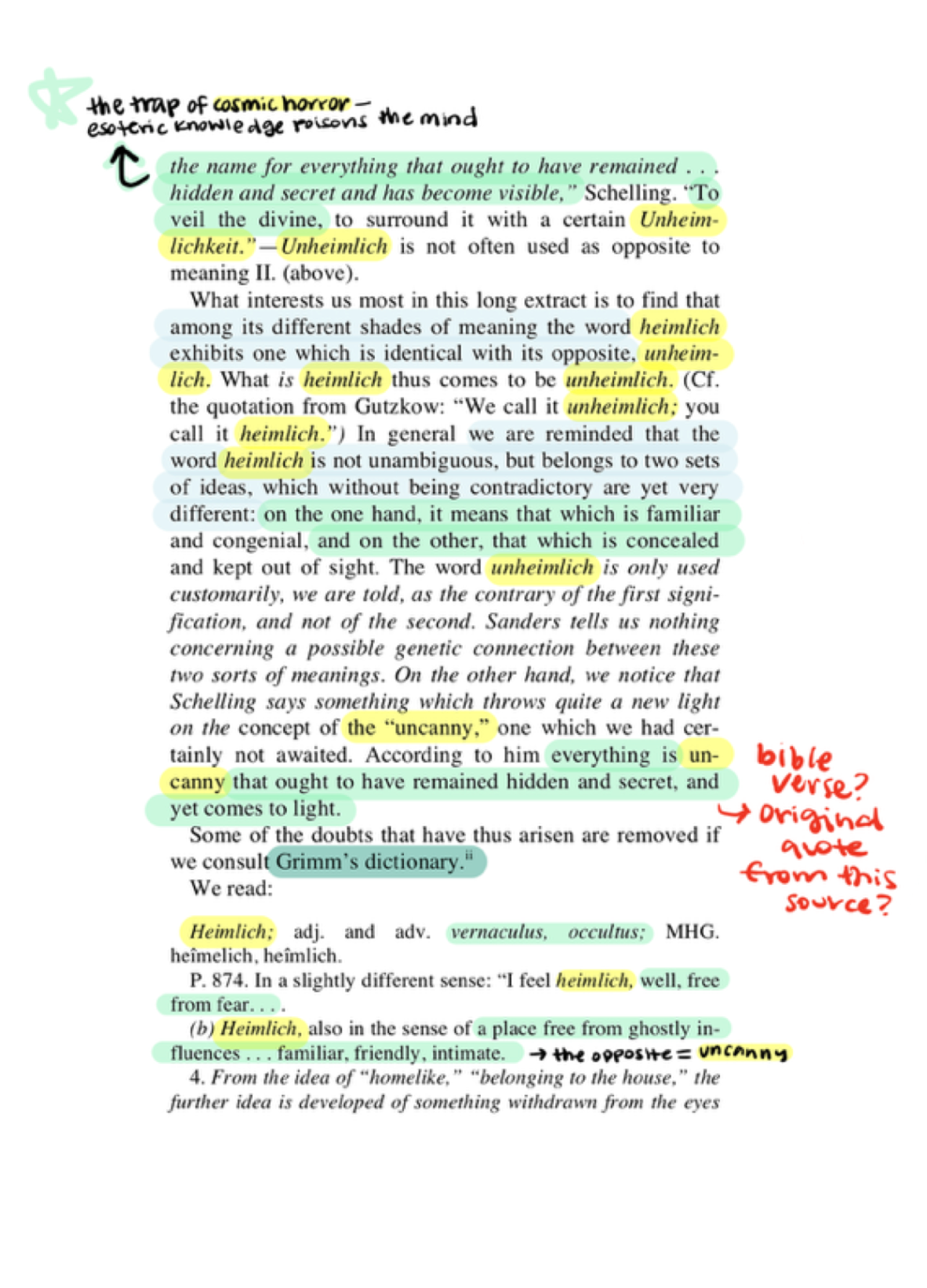
Compounds and especially also the opposite follow meaning I. (above): Unheimlich, uneasy, eerie, bloodcurdling; “Seeming almost unheimlich and ‘ghostly’ to him.” “I had already long since felt an unheimlich, even gruesome feeling.” “Feels an unheimlich horror.” “Unheimlich and motionless like a stone-image.” “The unheimlich mist called hill-fog.” “These pale youths are unheimlich and are brewing heaven knows what mischief.” “Unheimlich” is
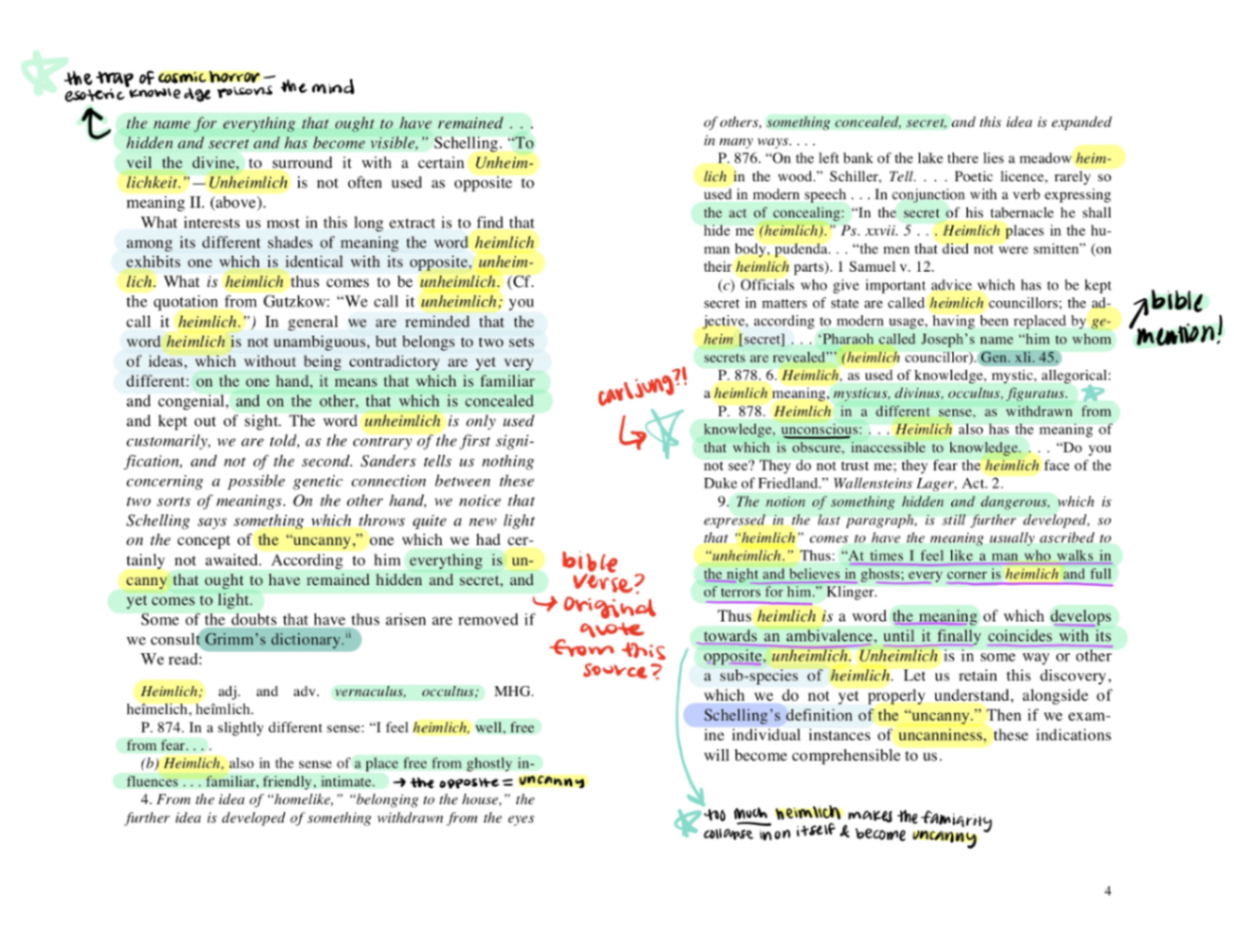
the name for everything that ought to have remained . . . hidden and secret and has become visible,” Schelling. “Toveilthe divine, to surround it with a certainUnheimlichkeit.”—Unheimlich is not often used asoppositetomeaning II. (above).
My analysis:
In my own words:
My annotations:
[*] get 1st half of quote from page 3!! // the name for everything that ought to have remained . . . hidden and secret and has become visible,”
the trap of cosmic horror — esoteric knowledge poisons the mind
What interests us most in this long extract is to find that among its different shades of meaning the word heimlich exhibits one which is identical with its opposite, unheimlich. What is heimlich thus comes to be unheimlich. (Cf. the quotation from Gutzkow: “We call it unheimlich; you call it heimlich.”) In general we are reminded that the word heimlich is notunambiguous,but belongs to two sets of ideas, which without beingcontradictoryare yet very different: on the one hand, it means that which isfamiliarandcongenial,and on the other, that which isconcealedand kept out ofsight. The word unheimlich is only used customarily, we are told, as the contrary of the first signification, and not of the second. Sanders tells us nothing concerning a possible genetic connection between these two sorts of meanings. On the other hand, we notice that Schelling says something which throws quite a new light on the concept of the “uncanny,” one which we had certainly not awaited. According to him everything is uncanny that ought to have remained hidden and secret, and yet comes to light.
My analysis:
In my own words:
My annotations:
[I] ”everything is uncanny that ought to have remained hidden and secret, and yet comes to light.“
Some of the doubts that have thus arisen are removed if we consult Grimm’s dictionary. ^ ii
We read:
Heimlich; adj. and adv. vernaculus, occultus; MHG. heîmelich, heîmlich. P. 874. In a slightly different sense: “I feel heimlich, well, free from fear. . . . (b) Heimlich, also in the sense of a place free from ghostly influences . . . familiar, friendly, intimate.
My analysis:
In my own words:
My annotations:
[I] ”a place free from ghostly influences”
the opposite = uncanny
4 ) From the idea of “homelike,” “belonging to the house,” the further idea is developed of something withdrawn from the eyes
of others, something concealed, secret, and this idea is expanded in many ways. . .
P. 876. "On the left bank of the lake there lies a meadow heimlich in the wood.” Schiller, Tell. . . . Poetic licence, rarely so used in modern speech . . . In conjunction with a verb expressing the act of concealing: "In the secret of his tabernacle he shall hide me (heimlich).” Ps. xxvii. 5 . . . Heimlich places in the human body, pudenda. . . "the men that died not were smitten" (on their heimlich parts). 1 Samuel v. 12.
(c) Officials who give important advice which has to be kept secret in matters of state are called heimlich councillors; the adjective, according to modern usage, having been replaced by geheim [secret] . . . "Pharaoh called Joseph's name 'him to whom secrets are revealed‘“ (heimlich councillor). Gen. xli. 45.
My analysis:
In my own words:
My annotations:
[I] "Pharaoh called Joseph's name 'him to whom secrets are revealed‘“ (heimlich councillor). Gen. xli. 45.
Bible mention!
P. 878. 6. Heimlich, as used of knowledge, mystic, allegorical: a heimlich meaning, mysticus, divinus, occultus, figuratus.
P. 878. Heimlich in a different sense, as withdrawn from knowledge, unconscious: . . . Heimlich also has the meaning of that which is obscure, inaccessible to knowledge. . . "Do you not see? They do not trust me; they fear the heimlich face of the Duke of Friedland." Wallensteins Lager, Act. 2.
9 ) The notion of somethinghiddenanddangerous, which is expressed in the last paragraph, is still further developed, so that ”heimlich” comes to have the meaning usually ascribed to “unheimlich.” Thus: “At times I feel like a man who walks in the night and believes in ghosts; every corner isheimlichand full ofterrorsfor him.” Klinger.
Thus heimlich is a word the meaning of which develops towards anambivalence,until it finally coincides with itsopposite,unheimlich.Unheimlich is in some way or other a sub-species of heimlich. Let us retain this discovery, which we do not yet properly understand, alongside of Schelling’s definition of the "uncanny." Then if we examine individual instances of uncanniness, these indications will become comprehensible to us.
My analysis:
In my own words:
My annotations:
The Paradox of Familiarity
When something is excessively heimlich (familiar/homely), it undergoes a collapse of meaning where the sense of familiarity turns into its opposite, becoming unheimlich (uncanny).
[*] Thus heimlich is a word the meaning of which develops towards anambivalence,until it finally coincides with itsopposite,unheimlich.
too MUCH heimlich makes the familiarity collapse in on itself & become uncanny
When the quality of being heimlich (homely, familiar, or secret) becomes excessive, the sense of familiarity collapses into its own opposite, resulting in the unheimlich (the uncanny).
The Semantic Evolution of Heimlich
The word heimlich undergoes a transition from its original sense of "homely" or "familiar" to a state of ambivalence where it ultimately converges with its opposite, unheimlich (the uncanny). This evolution occurs as the term shifts from denoting what is private, secret, or hidden, to encompassing the dangerous or terrifying qualities associated with the unknown. In this context, unheimlich functions as a sub-species of heimlich, suggesting that the uncanny is deeply rooted in the familiar. By tracing this linguistic shift, one can better understand the psychological and philosophical implications of the uncanny.
Uncanny — Page 5
Uncanny — Page 5
My analysis:
In my own words:
My annotations:
The Psychological Basis of the Uncanny
The uncanny arises from an intellectual uncertainty regarding the nature of an entity's animation. When a spectator cannot distinguish between a living being and a mechanical imitation, the resulting cognitive dissonance creates a sense of dread. This is amplified when:
Artificiality: Lifeless objects (wax figures, dolls, automatons) mimic the human form so closely that they create doubt about their status.
Mechanical Behavior: Signs of insanity or seizures suggest that human behavior is being driven by "automatic, mechanical processes" rather than conscious intent, stripping the subject of their humanity.
Narrative Strategy: To maintain this effect in storytelling, the author must withhold definitive answers, ensuring the audience remains in a state of unresolved tension. If the mystery is clarified, the uncanny sensation dissolves.
Terms
animate // alive
automatic // mechanical
lifeless
“Sand-Man” // the Sand-Man
Something Very Bad Is Going To Happen
II
In proceeding to review those things, persons, impressions, events and situations which are able to arouse in us a feeling of the uncanny in a very forcible and definite form, the first requirement is obviously to select a suitable example to start upon. Jentsch has taken as a very good instance “doubts whether an apparently animate being is really alive; or conversely, whether a lifeless object might not be in fact animate”; and he refers in this connection to the impression made by wax-work figures, artificial dolls and automatons. He adds to this class the uncanny effect of epileptic seizures and the manifestations ofinsanity, because these excite in the spectator the feeling thatautomatic, mechanical processesare at work,concealedbeneath the ordinary appearance ofanimation. Without entirely accepting the author’s view, we will take it as a starting-point for our investigation because it leads us on to consider a writer who has succeeded better than anyone else in producing uncanny effects.
My comments:
[I] “doubts whether an apparently animate being is really alive; or conversely, whether a lifeless object might not be in fact animate”
The Alice in Wonderland Effect: The uncanny universe inverts itself.
The Role of Narrative Uncertainty
Jentsch says: “In telling astory,one of the most successful devices for easily creatinguncannyeffects is to leave the reader inuncertaintywhether a particular figure in the story is a human being or an automaton; and to do it in such a way that his attention is not directly focused upon hisuncertainty,so that he may not be urged to go into the matter and clear it up immediately, since that, as we have said, would quickly dissipate thepeculiaremotionaleffect of the thing.” Hoffmann has repeatedly employed this psychological artifice with success in his fantastic narratives.
My comments:
To linger in the uncertainty without explicitly focusing on it creates a specific psychological state that sustains the uncanny effect.
This observation, undoubtedly a correct one, refers primarily to the story of “The Sand-Man” in Hoffmann’s Nachtstücken, which contains the original of Olympia, the doll in the first act of Offenbach’s opera, Tales of Hoffmann.
^6 [From Haus = house; Häuslichkeit = domestic life. —Trans.]
Hoffmann. But I cannot think—and I hope that most readers of the story will agree with me—that the theme of the doll, Olympia, who is to all appearances a living being, is by any means the only element to be held responsible for the quite unparalleled atmosphere of uncanniness which the story evokes; or, indeed, that it is the most important among them. Nor is this effect of the story heightened by the fact that the author himself treats the episode of Olympia with a faint touch of satire and uses it to make fun of the young man’s idealization of his mistress. The main theme of the story is, on the contrary, something different, something which gives its name to the story, and which is always re-introduced at the critical moment: it is the theme of the “Sand-Man” who tears out children’s eyes.
This fantastic tale begins with the childhood recollections of the student Nathaniel: in spite of his present happiness, he cannot banish the memories associated with the mysterious and terrifying death of the father he loved. On certain evenings his mother used to send the children to bed early, warning them that “the Sand-Man was coming”; and sure enough Nathaniel would not fail to hear the heavy tread of a visitor with whom his father would then be occupied that evening. When questioned about the Sand-Man, his mother, it is true, denied that such a person existed except as a form of speech; but his nurse could give him more definite information: “He is a wicked man who comes when children won’t go to bed, and throws handfuls of sand in their eyes so that they jump out of their heads all bleeding. Then he puts the eyes in a sack and carries them off to the moon to feed his children. They sit up there in their nest, and their beaks are hooked like owls’ beaks, and they use them to peck up naughty boys’ and girls’ eyes with.”
My comments:
[*] his mother used to send the children to bed early, warning them that “the Sand-Man was coming”
reminds me of the creepy old man legend in Something Very Bad Is Going To Happen
Although little Nathaniel was sensible and old enough not to believe in such gruesome attributes to the figure of the Sand-Man, yet the dread of him became fixed in his…
5
Uncanny — Page 6 // good enough for now,but maybe re-format later
Uncanny — Page 6
My comments:
delirious // delirium
panic-stricken
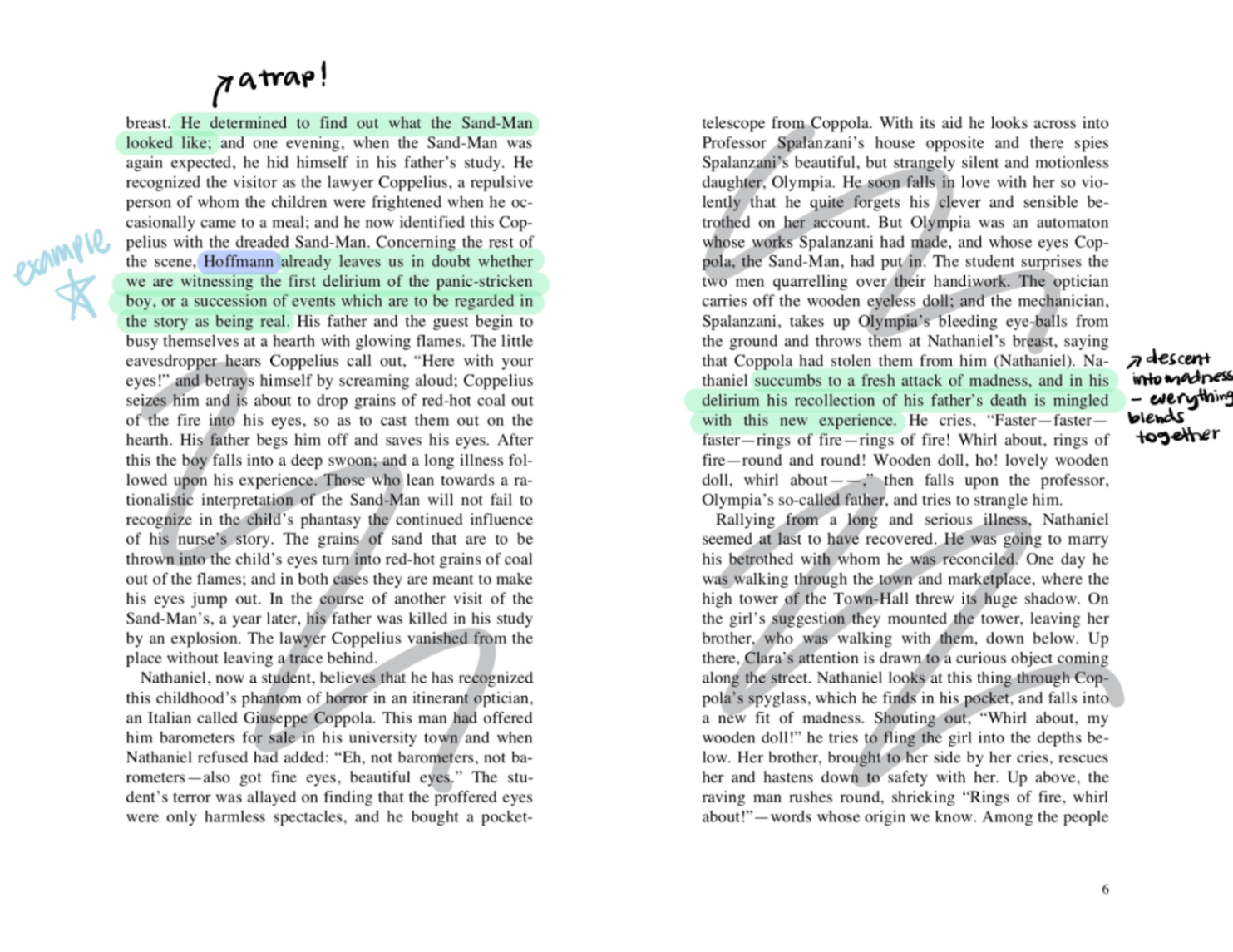
breast. He determined to find out what the Sand-Man looked like; and one evening, when the Sand-Man was again expected, he hid himself in his father’s study. He recognized the visitor as the lawyer Coppelius, a repulsive person of whom the children were frightened when he occasionally came to a meal; and he now identified this Coppelius with the dreaded Sand-Man. Concerning the rest of the scene, Hoffmann already leaves us in doubt whether we are witnessing the first delirium of the panic-stricken boy, or a succession of events which are to be regarded in the story as being real. His father and the guest begin to busy themselves at a hearth with glowing flames. The little eavesdropper hears Coppelius call out, “Here with your eyes!” and betrays himself by screaming aloud; Coppelius seizes him and is about to drop grains of red-hot coal out of the fire into his eyes, so as to cast them out on the hearth. His father begs him off and saves his eyes. After this the boy falls into a deep swoon; and a long illness followed upon his experience. Those who lean towards a rationalistic interpretation of the Sand-Man will not fail to recognize in the child’s phantasy the continued influence of his nurse’s story. The grains of sand that are to be thrown into the child’s eyes turn into red-hot grains of coal out of the flames; and in both cases they are meant to make his eyes jump out. In the course of another visit of the Sand-Man’s, a year later, his father was killed in his study by an explosion. The lawyer Coppelius vanished from the place without leaving a trace behind. Nathaniel, now a student, believes that he has recognized this childhood’s phantom of horror in an itinerant optician, an Italian called Giuseppe Coppola. This man had offered him barometers for sale in his university town and when Nathaniel refused had added: “Eh, not barometers, not barometers—also got fine eyes, beautiful eyes.” The student’s terror was allayed on finding that the proffered eyes were only harmless spectacles, and he bought a pocket
My comments:
[I] “determined to find out what the Sand-Man looked like“
a trap!!!
[*] leaves us in doubt whether we are witnessing the first delirium of the panic-stricken boy, or a succession of events which are to be regarded in the story as being real.
telescope from Coppola. With its aid he looks across into Professor Spalanzani’s house opposite and there spies Spalanzani’s beautiful, but strangely silent and motionless daughter, Olympia. He soon falls in love with her so violently that he quite forgets his clever and sensible betrothed on her account. But Olympia was an automaton whose works Spalanzani had made, and whose eyes Coppola, the Sand-Man, had put in. The student surprises the two men quarrelling over their handiwork. The optician carries off the wooden eyeless doll; and the mechanician, Spalanzani, takes up Olympia’s bleeding eye-balls from the ground and throws them at Nathaniel’s breast, saying that Coppola had stolen them from him (Nathaniel). Nathaniel succumbs to a fresh attack of madness, and in his delirium his recollection of his father’s death is mingled with this new experience. He cries, “Faster—faster—faster—rings of fire—rings of fire! Whirl about, rings of fire—round and round! Wooden doll, ho! lovely wooden doll, whirl about——,” then falls upon the professor, Olympia’s so-called father, and tries to strangle him.
My comments:
[I] ”succumbs to a fresh attack of madness, and in his delirium his recollection of his father’s death is mingled with this new experience.”
descent into madness — everything melts together
Descent into Madness: Everything Melts Together
The protagonist’s psychological stability collapses as his traumatic past memories of his father’s death merge with his current horrific experiences. This mental disintegration causes his reality to blur, where sensory perceptions of "rings of fire" and the haunting image of the "wooden doll" become inseparable, leading him into a chaotic state of violent delusion.
Rallying from a long and serious illness, Nathaniel seemed at last to have recovered. He was going to marry his betrothed with whom he was reconciled. One day he was walking through the town and marketplace, where the high tower of the Town-Hall threw its huge shadow. On the girl’s suggestion they mounted the tower, leaving her brother, who was walking with them, down below. Up there, Clara’s attention is drawn to a curious object coming along the street. Nathaniel looks at this thing through Coppola’s spyglass, which he finds in his pocket, and falls into a new fit of madness. Shouting out, “Whirl about, my wooden doll!” he tries to fling the girl into the depths below. Her brother, brought to her side by her cries, rescues her and hastens down to safety with her. Up above, the raving man rushes round, shrieking “Rings of fire, whirl about!”—words whose origin we know. Among the people
Uncanny — Page 7
Uncanny — Page 7
My comments:
theory of "intellectual uncertainty"
madman
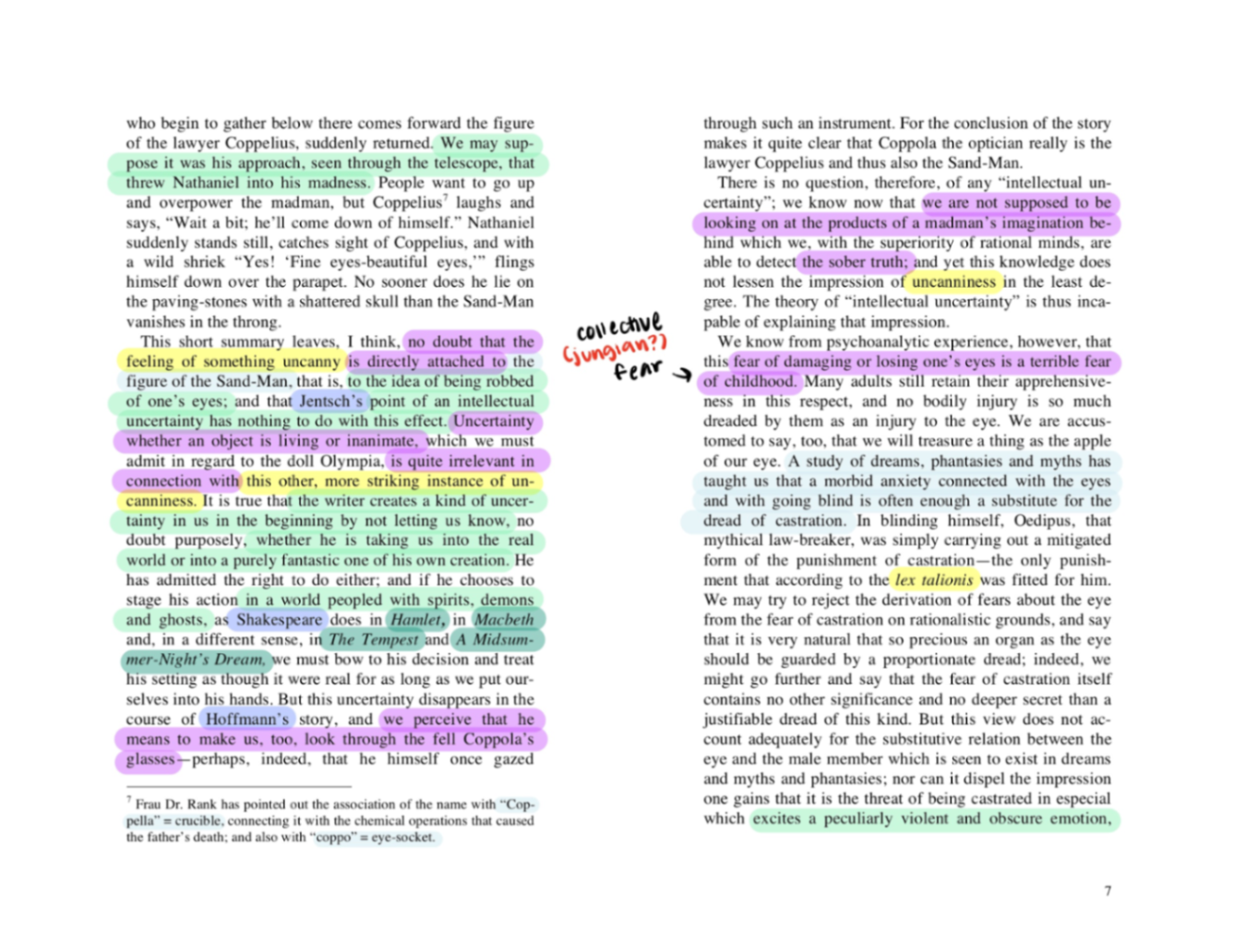
who begin to gather below there comes forward the figure of the lawyer Coppelius, suddenly returned. We may suppose it was his approach, seen through the telescope, that threw Nathaniel into his madness. People want to go up and overpower the madman, but Coppelius⁷ laughs and says, “Wait a bit; he’ll come down of himself.” Nathaniel suddenly stands still, catches sight of Coppelius, and with a wild shriek “Yes! ‘Fine eyes-beautiful eyes,’” flings himself down over the parapet. No sooner does he lie on the paving-stones with a shattered skull than the Sand-Man vanishes in the throng.
This short summary leaves, I think, no doubt that the feeling of something uncanny is directly attached to the figure of the Sand-Man, that is, to the idea of being robbed of one’s eyes; and that Jentsch’s point of an intellectual uncertainty has nothing to do with this effect. Uncertaintywhether an object is living orinanimate, which we must admit in regard to the doll Olympia, is quiteirrelevantin connection with this other, more striking instance ofuncanniness. It is true that the writer creates a kind of uncertainty in us in the beginning by not letting us know, no doubt purposely, whether he is taking us into the real world or into a purely fantastic one of his own creation. He has admitted the right to do either; and if he chooses to stage his action in a world peopled with spirits, demons and ghosts, as Shakespeare does in Hamlet, in Macbeth and, in a different sense, in The Tempest and A Midsummer-Night’s Dream, we must bow to his decision and treat his setting as though it were real for as long as we put ourselves into his hands. But this uncertainty disappears in the course of Hoffmann’s story, and we perceive that he means to make us, too, look through the fell Coppola’s glasses—perhaps, indeed, that he himself once gazed
⁷ Frau Dr. Rank has pointed out the association of the name with “Coppella” = crucible, connecting it with the chemical operations that caused the father’s death; and also with “coppo/coppia?” = eye-socket.
through such an instrument. For the conclusion of the story makes it quite clear that Coppola the optician really is the lawyer Coppelius and thus also the Sand-Man.
There is no question, therefore, of any "intellectual uncertainty"; we know now that we are not supposed to be looking on at the products of amadman'simagination behind which we, with the superiority of rational minds, are able to detect the sober truth; and yet this knowledge does not lessen the impression ofuncanninessin the least degree. The theory of "intellectual uncertainty" is thus incapable of explaining that impression.
Collective (Jungian) Fear // Castration Fear
We know from psychoanalytic experience, however, that this fear of damaging or losing one's eyes is a terrible fear of childhood. Many adults still retain their apprehensiveness in this respect, and no bodily injury is so much dreaded by them as an injury to the eye. We are accustomed to say, too, that we will treasure a thing as the apple of our eye.
My comments:
[I] we are not supposed to be looking on at the products of amadman'simagination behind which we, with the superiority of rational minds, are able to detect the sober truth; and yet this knowledge does not lessen the impression ofuncanninessin the least degree.
the fear of damaging or losing one's eyes is a pervasive, deep-seated fear rooted in childhood
A study of dreams, phantasies and myths has taught us that a morbid anxiety connected with the eyes and with going blind is often enough a substitute for the dread of castration. In blinding himself, Oedipus, that mythical law-breaker, was simply carrying out a mitigated form of the punishment of castration—the only punishment that according to the lex talionis was fitted for him.
We may try to reject the derivation of fears about the eye from the fear of castration on rationalistic grounds, and say that it is very natural that so precious an organ as the eye should be guarded by a proportionate dread; indeed, we might go further and say that the fear of castration itself contains no other significance and no deeper secret than a justifiable dread of this kind. But this view does not account adequately for the substantive relation between the eye and the male member which is seem to exist in dreams and myths and phantasies; nor can it dispel the impression one gains that it is thethreatof being castrated in special which excites a peculiarlyviolentandobscureemotion.
Uncanny — Page 8
Uncanny — Page 8
and this emotion is what first gives the idea of losing ones eyes its intense colouring. All further doubts are removed when we get the details of their "castration-complex" from the analyses of neurotic patients, and realize its immense importance in their mental life.
Moreover, I would not recommend any opponent of the psychoanalytic view to select precisely the story of the Sand-Man upon which to build his case that morbid anxiety about the eyes has nothing to do with the castration-complex. For why does Hoffmann bring the anxiety about eyes into such intimate connection with the father's death? And why does the Sand-Man appear each time in order to interfere with love? He divides the unfortunate Nathaniel from his betrothed and from her brother, his best friend; he destroys his second object of love, Olympia, the lovely doll; and he drives him into suicide at the moment when he has won back his Clara and is about to be happily united to her. Things like these and many more seem arbitrary andmeaninglessin thestoryso long as we deny all connection betweenfearsabout the eye andcastration,but they become intelligible as soon as we replace the Sand-Man by thedreadedfather at whose handscastrationis awaited.
My comments:
The Duality of the Father Figure
The father figure is split by the ambivalence of the child's feeling: whereas the one threatens to blind him, that is, to castrate him, the other, the loving father, intercedes for his sight. That part of the complex which is most strongly repressed, the death wish against the father, finds expression in the death of the good father, and Coppelius is made answerable for it. Later, in his student days, Professor Spalanzani and Coppola the optician reproduce this double representation of the father-image, the Professor as a member of the father-series, Coppola openly identified with the lawyer Coppelius. Just as before they used to work together over the fire, so now they have jointly created the doll Olympia; the Professor is even called the father of Olympia. This second occurrence of work in common shows that the optician and the mechanic are one and the same person.
Footnotes
8 In fact, Hoffmann’s imaginative treatment of his material has not played such havoc with its elements that we cannot reconstruct their original arrangement. In the story from Nathaniel’s childhood, the figures of his father and Coppelius represent the two opposites into which thefather-imagois split by theambivalenceof the child’s feeling; whereas the onethreatensto blind him, that is, tocastratehim, the other, the loving father, intercedes for hissight. That part of the complex which is most strongly repressed, the death-wish against the father, finds expression in the death of the good father, and Coppelius is made answerable for it. Later, in his student days, Professor Spalanzani and Coppola the optician reproduce this double representation of the father-imago, the Professor as a member of the father-series, Coppola openly identified with the lawyer Coppelius. Just as before they used to work together over the fire, so now they have jointly created the doll Olympia; the Professor is even called the father of Olympia. This second occurrence of work in common shows that the optician and the mechani cian are also components of the father-imago, that is, both are Nathaniel’s father as well as Olympia’s. I ought to have added that in the terrifying scene in childhood, Coppelius, after sparing Nathaniel’s eyes, had screwed off his arms and legs as an experiment; that is, he had experimented on him as a mechanician would on a doll. This singular feature, which seems quite out of perspective in the picture of the Sand-Man, introduces a new castration-equivalent; but it also emphasizes the identity of Coppelius and his later counterpart, Spalanzani the mechanician, and helps us to understand who Olympia is. She, the automatic doll, can be nothing else than a personification of Nathaniel’s feminine attitude towards his father in his infancy. The father of both, Spalanzani and Coppola, are, as we know, new editions, reincarnations of Nathaniel’s “two” fathers. Now Spalaazani’s otherwise incomprehensible statement that the optician has stolen Nathaniel’s eyes so as to set them in the doll becomes significant and supplies fresh evidence for the identity of Olympia and Nathaniel. Olympia is, as it were, a dissociated complex of Nathaniel’s which confronts him as a person, and Nathaniel’s enslavement to this complex is expressed in his senseless obsessive love for Olympia. We may with justice call such love narcissistic, and can understand why he who has fallen victim to it should relinquish his real, external object of love. The psychological truth of the situation in which the young man, fixated upon his father by his castration-complex, is incapable of loving a woman, is amply proved by numerous analyses of patients whose story, though less fantastic, is hardly less tragic than that of the student Nathaniel. Hoffmann was the child of an unhappy marriage. When he was three years old, his father left his small family, never to be united to them again. According to Grisebach, in his biographical introduction to Hoffmann’s works, the writer’s relation to his father was always a most sensitive subject with him.
We shall venture, therefore, to refer the uncanny effect of the Sand-Man to the child's dread in relation to its castration complex. But having gained the idea that we can take this infantile factor to account for feelings of uncanniness, we are drawn to examine whether we can apply it to other instances of uncanny things. We find in the story of the Sand-Man the other theme upon which Jentsch lays stress, of a doll that appears to be alive. Jentsch believes that a particularly favourable condition for awakeninguncanny sensationsis created when there isintellectualuncertaintywhether an object isaliveor not, and whenan inanimate objectmay be taken to bealive;or conversely, whena lifeless objectmay be endowed with life.
My analysis:
In my own words:
My annotations:
[I] Jentsch believes that a particularly favourable condition for awakeninguncanny sensationsis created when there isintellectualuncertaintywhether an object isaliveor not, and whenan inanimate objectmay be taken to bealive;or conversely, whena lifeless objectmay be endowed with life.
[The preceding text discusses the Sand-Man, and the following text refers back to it].
The figures of Coppelius and Spalanzani are also components of the father image, that is, both are Nathanial's father as well as Olympia's. I might have added that in the terrifying scene in childhood, Coppelius, after sparing Nathaniel's eyes, had screwed off his arms and legs as an experiment; that is, he had experimented on him as a mechanician would on a doll. This singular feature, which seems quite out of perspective in the picture of the Sand-Man, induces a new castration-equivalent, but it also emphasizes the identity of Coppelius and his later counterpart, Spalanzani the mechanician, and helps us to understand who Olympia is. She, the automatic doll, can be nothing else than a personification of Nathaniel's feminine attitude towards his father in his infancy. The father of both, Spalanzani and Coppelius, are, as we know, new editions, reincarnations of Nathaniel's "two" fathers. Now Spalanzani's otherwise incomprehensible statement that the optician has stolen Nathaniel's eyes so as to set them in the doll becomes significant and supplies fresh evidence for the identity of Olympia and Nathaniel. Olympia is, as it were, a dissociated complex of Nathaniel's which confronts him as a person, and Nathaniel's endorsement to this complex is expressed in his senseless obsessive love for Olympia. We may with justice call such love narcissistic, and can understand why he who has fallen victim to it should relinquish his real, external object of love. The psychological truth of the situation in which the young man, fixated upon his father by his castration-complex, is incapable of loving a woman, is amply proved by numerous analyses of patients whose story, though less fantastic, is hardly less tragic than that of the student Nathaniel.
Hoffmann was the child of an unhappy marriage. When he was three years old, his father left his small family, never to be united to them again. According to Grisebach, in his biographical introduction to Hoffmann's works, the writer's relation to his father was always a most sensitive subject with him.
Jentsch believes that a particularly favourable condition for awakening uncanny sensations is created when there is intellectual uncertainty whether an object is alive or not, and when an inanimate object becomes too much like an animate one. Now, dolls happen to be rather closely connected with infantile life. We remember that in their early games children do not distinguish at all sharply between living and lifeless objects, and that they are especially fond of treating their dolls like live people. In fact I have occasionally heard a woman patient declare that even at the age of eight she had still been convinced that her dolls would be certain to come to life if she were to look at them in a particular way, with as concentrated a gaze as possible. So that here, too, it is not difficult to discover a factor from childhood; but curiously enough, while the Sand-Man story deals with the excitation of an early childhood fear, the idea of a “living doll” excites no fear at all; the child had no fear of its doll coming to life, it may even have desired it. The source of the feeling of an uncanny thing would not, therefore, be an infantile fear in this case, but rather an infantile wish or even only an infantile belief. There seems to be a contradiction here; but perhaps it is only a complication, which may be helpful to us later on.
My comments:
[I] ”intellectual uncertainty whether an object is alive or not“
“intellectual uncertainty” a.k.a. your mind playing tricks on you
Hoffmann is in literature the unrivalled master of conjuring up the uncanny. His Elixire des Teufels [The Devil’s Elixir] contains a mass of themes to which one is tempted to ascribe the uncanny effect of the narrative; but it is too obscure and intricate a story to venture to summarize. Towards the end of the book the reader is told the facts, from which the action springs;with the result, not that he is at last enlightened, but that he falls into a state of completebewilderment.The author has piled uptoo much of a kind;one’s comprehension of the wholesuffersas a result, though not the impression it makes. We must content ourselves with selecting those themes of uncanniness which are most prominent, and seeing whether we can fairly trace then also back to infantile sources. These themes are all concerned with the idea of a"double"in every shape and degree, with persons, therefore, who are to be considered identical by reason of looking alike; Hoffmann accentuates this relation by transferring mental processes from the one person to the other—what we should call telepathy—so that the one possesses knowledge, feeling and experience in common with the other, identifies himself with another person, so that his self becomesconfounded,or theforeignself is substituted for his own—in other words, by doubling, dividing and interchanging the self.
My comments:
[I] The author has piled uptoo much of a kind;one’s comprehension of the wholesuffersas a result, though not the impression it makes.
[I] ”These themes are all concerned with the idea of a"double"in every shape and degree, with persons who, to be considered identical may be taken as a"double"ordoppelgängers,but are WRONG!”
backrooms still lifes!!
doppelgängers but remembered WRONG & reduced to nothing
[*] ”telepathy” // what we should call telepathy—so that the one possesses knowledge, feeling and experience in common with the other, identifies himself with another person, so that his self becomesconfounded,or theforeignself is substituted for his own // ”by doubling, dividing and interchanging the self”
I just imagine a baby/embryo malforming & growing from a deformed DNA strand // Frankenstein vibes
sons, therefore, who are to be considered identical by reason of looking alike; Hoffmann accentuates this relation by transferring mental processes from the one person to the other—what we should call telepathy—so that the one possesses knowledge, feeling and experience in common with the other, identifies himself with another person, so that his self becomes confounded, or the foreign self is substituted for his own—in other words, by doubling, dividing and interchanging the self. And finally there is the constant recurrence of similar situations, a same face, or character-trait, or twist of fortune, or a same crime, or even a same name recurring throughout several consecutive generations.
The theme of the “double” has been very thoroughly treated by Otto Rank. He has gone into the connections the“double”has withreflectionsin mirrors, withshadows, guardian spirits, with the belief in the soul and thefearof death; but he also lets in a flood of light on the astonishing evolution of this idea. For the “double” was originally an insurance against destruction to the ego, an “energetic denial of the power of death,” as Rank says; and probably the “immortal” soul was the first “double” of the body. This invention of doubling as a preservation against extinction has its counterpart in the language of dreams, which is fond of representing castration by a doubling or multiplication of the genital symbol; the same desire spurred on the ancient Egyptians to the art of making images of the dead in some lasting material. Such ideas, however, have sprung from the soil of unbounded self-love, from the primary narcissism which holds sway in the mind of the child as in that of primitive man; and when this stage has been left behind the double takes on a different aspect. From having been an assurance of immortality, he becomes theghastly harbinger of death.
My comments:
[I] ”From having been an assurance of immortality, he becomes theghastly harbinger of death.”
a living cautionary tale
[I] ”the connections the“double”has withreflectionsin mirrors, withshadows, guardian spirits, with the belief in the soul and thefearof death“
Analysis of the Double
A "playing god" / "playing with fire" aspect: The creation of a double acts as a form of defiance against mortality.
A living counteracting force: The double initially serves as a survival mechanism, but eventually transforms from a symbol of life and immortality into an omen or messenger of death.
"The Doppelgänger"
The Evolution of the Double
The concept of the "double" functions as a psychological mechanism with two distinct phases in its evolution:
Protective Phase: Initially, the double serves as an ego-defense mechanism. By creating a representation of the self that can exist outside the physical body (such as the soul, reflections, or monuments), the individual attempts to deny the reality of death and ensure the preservation of the ego. This is rooted in infantile narcissism and the desire to control one's own mortality.
Ominous Phase: As the individual matures and moves past the stage of primary narcissism, the perception of the double shifts. It ceases to be a comforting assurance of immortality and transforms into a threatening omen or a "ghastly harbinger" of death.
The Concept of the "Double"
The "double" acts as a manifestation of the uncanny, representing entities that appear identical to a person or object but possess an unsettling, "wrong," or distorted quality. These manifestations include:
Doppelgängers: Individuals who appear to be exact replicas of a person, creating a psychological disturbance regarding identity and self-recognition.
Backrooms and Still Lifes: Objects or environments that mimic reality with unnatural precision or stillness, triggering a sense of alienation where the familiar becomes eerie because it lacks the expected vitality or authenticity of its animate counterparts.
The Concept of the Double
The psychological phenomenon of the "double" or doppelgänger involves a subject perceiving another person as their own self, leading to a sense of uncanniness. This feeling arises because the double is perceived as both identical to the self and fundamentally "wrong" or alien. These manifestations are often traced back to infantile origins, where the boundaries between the self and others, or the self and objects, were not clearly defined. When a double appears later in life, it triggers a regression to these early developmental stages, creating a jarring, eerie dissonance where the familiar (the self) is rendered strange.
Footnotes
⁹ "Der Doppelgänger."
Uncanny — Page 10
Uncanny — Page 10
My comments:
helpless // helplessness
illusion of Free Will
when Clark interacts w/ his own still life/entity
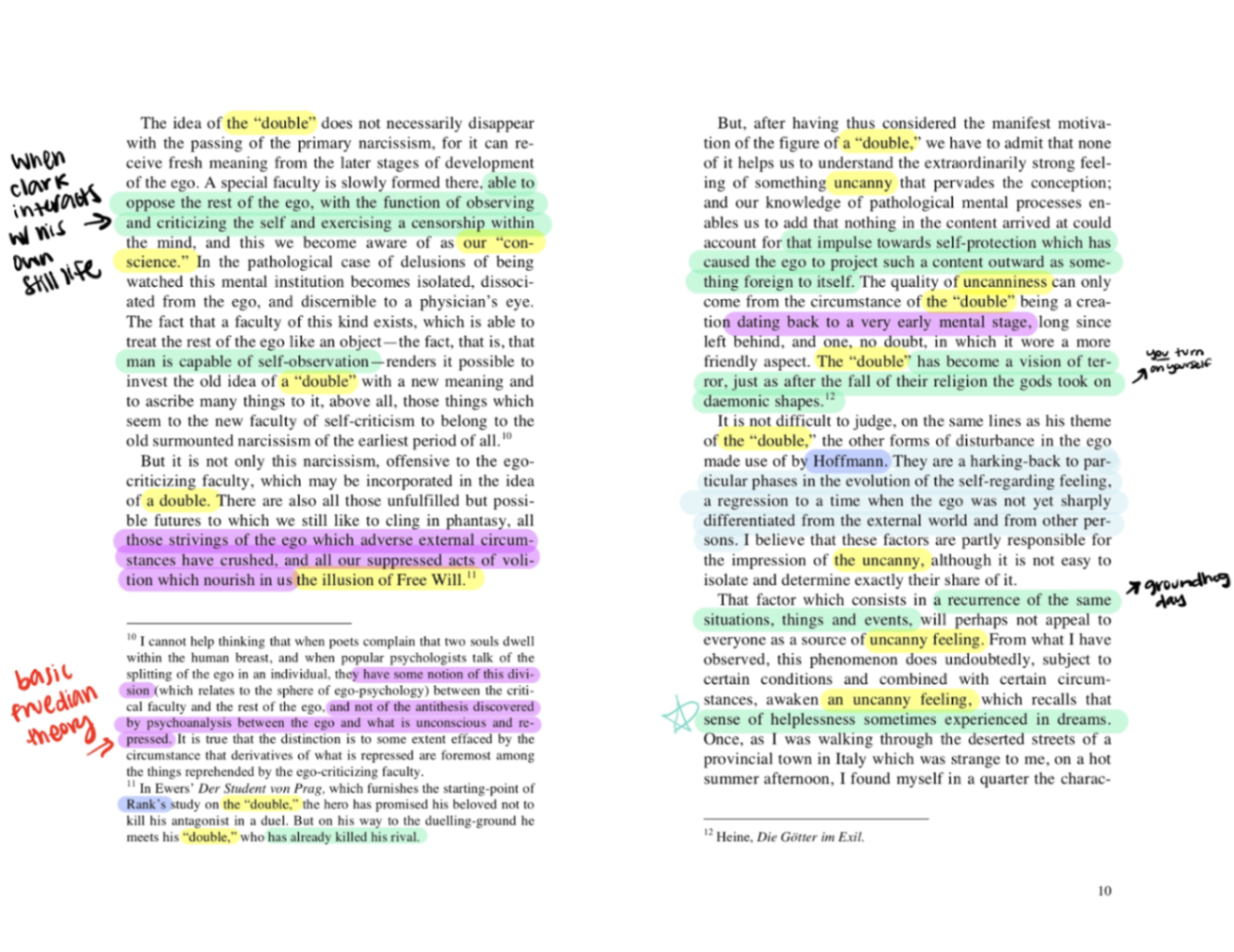
The idea of the "double" does not necessarily disappear with the passing of the primary narcissism, for it can receive fresh meaning from the later stages of development of the ego. A special faculty is slowly formed there, able toopposethe rest of theego, with the function of observing and criticizing the self and exercising a censorship within the mind, and this we become aware of as our "conscience." In the pathological case of delusions of being watched this mental institution becomes isolated, dissociated from the ego, and discernible to a physician’s eye. The fact that a faculty of this kind exists, which is able to treat the rest of the ego like an object—the fact, that, is, that man is capable of self-observation—renders it possible to invest the old idea of a "double" with a new meaning and to ascribe many things to it, above all, those things which seem to the new faculty of self-criticism to belong to the old surmounted narcissism of the earliest period of all.
But it is not only this narcissism, offensive to the ego-criticizing faculty, which may be incorporated in the idea of a double. There are also all those unfulfilled but possible futures to which we still like to cling in phantasy, all those strivings of theegowhich adverse external circumstances have crushed, and all our suppressed acts of volition which nourish in us theillusionof Free Will. 11
Footnotes
10 - I cannot help thinking that when poets complain that two souls dwell within the human breast, and when popular psychologists talk of the splitting of the ego in an individual, they have some notice of this division which relates to the sphere of ego-psychology: between the critical faculty and the rest of the ego, and not of the antithesis discovered by psychoanalysis between the ego and what is unconscious and repressed. It is true that the distinction is to some extent effaced by the circumstance that derivatives of what is repressed are feminine among the things apprehended by the ego-criticizing faculty.
My comments:
[I] man is capable of self-observation
[I] those strivings of theegowhich adverse external circumstances have crushed, and all our suppressed acts of volition which nourish in us theillusionof Free Will.
basic Freudian theory
11 – In Ewers’ Der Student von Prag, which furnishes the starting-point of Rank's study on the "double," the hero has promised his beloved not to kill his antagonist in a duel. But on his way to the dueling ground he meets his"double,"who has already killed his rival.
But, after having thus considered the manifest motivation of the figure of a "double," we have to admit that none of it helps us to understand the extraordinarily strong feeling of something uncanny that pervades the conception; and our knowledge of pathological mental processes enables us to add that nothing in the content arrived at could account for that impulse towards self-protection which has caused the ego to project such a content outward as something foreign to itself.The quality ofuncanninesscan only come from the circumstance of the"double"being a creation dating back to a very early mental stage, long since left behind, and one, no doubt, in which it wore a more friendly aspect.The"double"has become a vision ofterror,just as after the fall of theirreligionthegodstook ondaemonicshapes.¹²
My comments:
[I] that impulse towards self-protection which has caused the ego to project such a content outward as something foreign to itself.
[I] The"double"has become a vision ofterror,just as after the fall of theirreligionthegodstook ondaemonicshapes.
The double's ambivalence
You turn on yourself
Reflections on the Double
The concept of the "double" functions as an internal projection, where one effectively turns against oneself.
It is not difficult to judge, on the same lines as his theme of the "double," the other forms of disturbance in the ego made use of by Hoffmann. They are a harking-back to particular phases in the evolution of the self-regarding feeling, aregressionto a time when theegowas not yet sharply differentiated from the external world and from other persons. I believe that these factors are partly responsible for the impression of the uncanny, although it is not easy to isolate and determine exactly their share of it.
That factor which consists in a recurrence of the same situations, things and events, will perhaps not appeal to everyone as a source of uncanny feeling. From what I have observed, this phenomenon does undoubtedly, subject to certain conditions and combined with certain circumstances, awaken anuncannyfeeling, which recalls that sense ofhelplessnesssometimes experienced indreams. Once, as I was walking through the deserted streets of a provincial town in Italy which was strange to me, on a hot summer afternoon, I found myself in a quarter the character of which could not long remain in doubt.
My comments:
[*] awaken anuncannyfeeling, which recalls that sense ofhelplessnesssometimes experienced indreams. O
Recurrence and Repetition
[I] ”a recurrence of the same situations, things and events“
The phenomenon where the same situations, things, and events recur is analogous to the experience depicted in Groundhog Day.
¹ Heine, Die Götter im Exil.
Uncanny — Page 11
Uncanny — Page 11
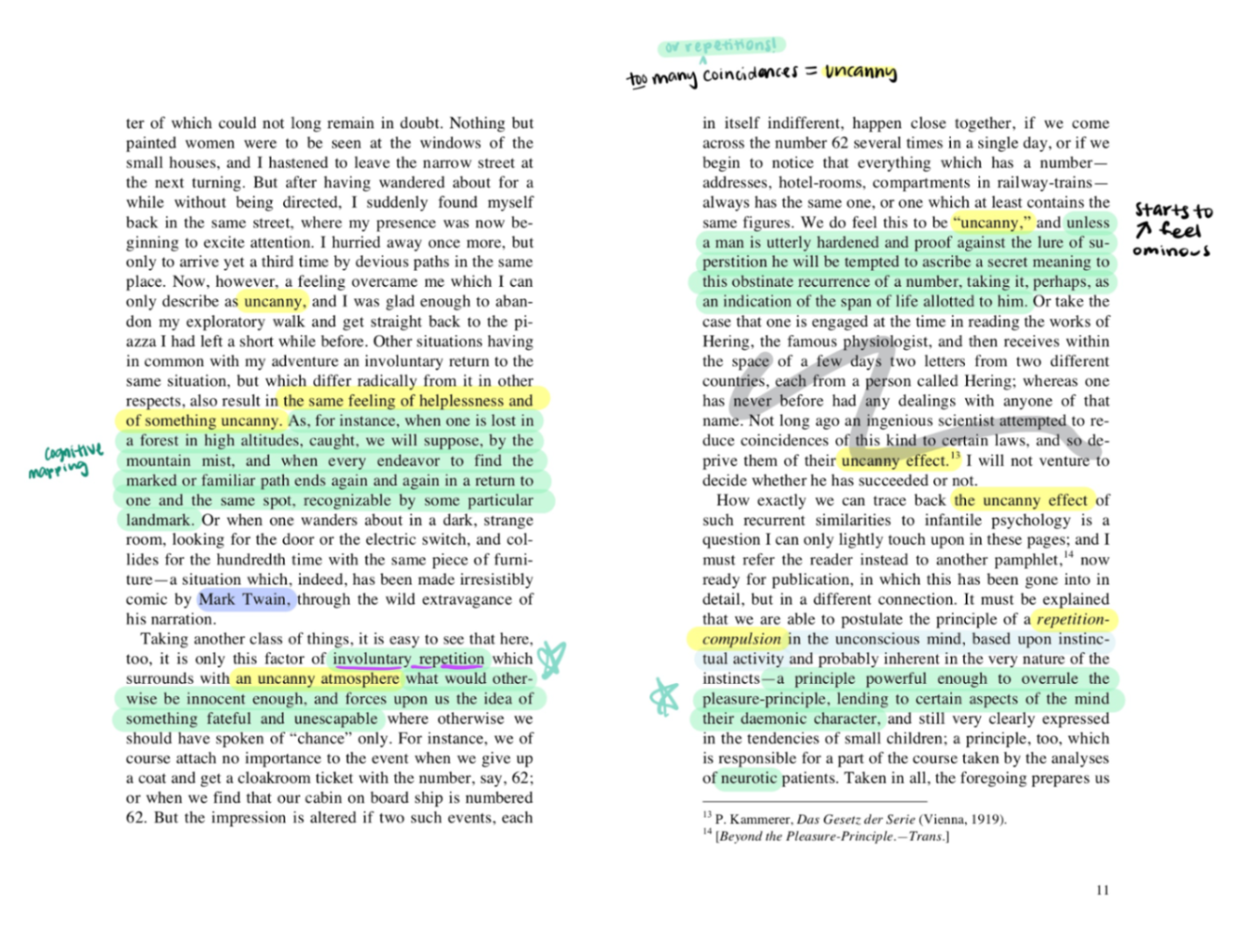
ter of which could not long remain in doubt. Nothing but painted women were to be seen at the windows of the small houses, and I hastened to leave the narrow street at the next turning. But after having wandered about for a while without being directed, I suddenly found myself back in the same street, where my presence was now beginning to excite attention. I hurried away once more, but only to arrive yet a third time by devious paths in the same place. Now, however, a feeling overcame me which I can only describe as uncanny, and I was glad enough to abandon my exploratory walk and get straight back to the piazza I had left a short while before. Other situations having in common with my adventure an involuntary return to the same situation, but which differ radically from it in other respects, also result in the same feeling of helplessness and of something uncanny. As, for instance, when one islostin a forest in high altitudes, caught, we will suppose, by the mountain mist, and when every endeavor to find the marked orfamiliarpath ends again and again in a return to one and the same spot, recognizable by some particular landmark. Or when one wanders about in a dark, strange room, looking for the door or the electric switch, and collides for the hundredth time with the same piece of furniture—a situation which, indeed, has been made irresistibly comic by Mark Twain, through the wild extravagance of his narration.
Taking another class of things, it is easy to see that here, too, it is only this factor of involuntary repetition which surrounds with an uncanny atmosphere what would otherwise be innocent enough, and forces upon us the idea of somethingfatefulandunescapablewhere otherwise we should have spoken of “chance” only. For instance, we of course attach no importance to the event when we give up a coat and get a cloakroom ticket with the number, say, 62; or when we find that our cabin on board ship is numbered 62. But the impression is altered if two such events, each
My comments:
fateful
inescapable // unescapable
[*] ”when one wanders about in a dark, strange room, looking for the door or the electric switch, and collides for the hundredth time with the same piece of furniture”
[*] this factor of involuntary repetition which surrounds with an uncanny atmosphere what would otherwise be innocent enough, and forces upon us the idea of somethingfatefulandunescapablewhere otherwise we should have spoken of “chance” only.
Cognitive Mapping
When an individual is lost in an unfamiliar environment, such as a forest at high altitude obscured by mist, the inability to locate a familiar path leads to a repetitive cycle of returning to the same location, often identified by a specific landmark. This phenomenon mirrors the experience of being in a dark, strange room and repeatedly encountering the same piece of furniture while searching for an exit or a light switch—a scenario famously depicted with humor in the works of Mark Twain.
The Concept of Involuntary Repetition
The experience of returning repeatedly to the same location, situation, or stimulus creates a sense of helplessness and foreboding. While individual events might be mundane or accidental, the persistent recurrence of these events transforms them into something that feels destined or unavoidable. This psychological effect—the feeling that an arbitrary occurrence is actually significant or sinister due to its repetition—is the core component of what is perceived as "uncanny."
My comments:
pleasure-principle
repetition-compulsion
neurotic
lure of superstition
or repetitions!
Starts to feel ominous
(Handwritten note: "as experience")
in itself indifferent, happen close together, if we come across the number 62 several times in a single day, or if we begin to notice that everything which has a number—addresses, hotel-rooms, compartments in railway-trains—always has the same one, or one which at least contains the same figures. We do feel this to be “uncanny,” and unless a man is utterly hardened and proof against thelure of superstitionhe will be tempted to ascribe asecret meaning to this obstinate recurrence of a number, taking it, perhaps, as an indication of the span of life allotted to him. Or take the case that one is engaged at the time in reading the works of Hering, the famous physiologist, and then receives within the space of a few days two letters from two different countries, each from a person called Hering; whereas one has never before had any dealings with anyone of that name. Not long ago an ingenious scientist attempted to reduce coincidences of this kind to certain laws, and so deprive them of their uncanny effect.13 I will not venture to decide whether he has succeeded or not.
My comments:
[I] unless a man is utterly hardened and proof against thelure of superstitionhe will be tempted to ascribe asecret meaning
too many coincidences = uncanny
The Uncanny Coincidences of Uncanny
How exactly we can trace back the uncanny effect of such recurrent similarities to infantile psychology is a question I can only lightly touch upon in these pages; and I must refer the reader instead to another pamphlet, now ready for publication, in which this has been gone into in detail, but in a different connection. It must be explained that we are able to postulate the principle of a repetition-compulsion in the unconscious mind, based upon instinctual activity and probably inherent in the very nature of the instincts—a principle powerful enough to overrule thepleasure-principle,lending to certain aspects of the mind theirdaemoniccharacter, and still very clearly expressed in the tendencies of small children; a principle, too, which is responsible for a part of the course taken by the analyses of neurotic patients. Taken in all, the foregoing prepares us
My comments:
[*] a principle powerful enough to overrule thepleasure-principle,lending to certain aspects of the mind theirdaemoniccharacter
13 P. Kammerer, Das Gesetz der Serie (Vienna, 1919). 14 [Beyond the Pleasure-Principle.—Trans.]
Uncanny — Page 12
Uncanny — Page 12
My comments:
The Ring of Polycrates
"eerie" (next to a star symbol)
"omen" (next to a star symbol)
The Mechanism of Uncanny Coincidence
The experience of the "uncanny" often arises from the perception of an inner repetition-compulsion. When an individual’s internal desires or wishes are manifested in external reality—such as a hostile thought being followed by a corresponding real-world event—the experience is perceived not as a mere coincidence, but as an unsettling intrusion. For an obsessional neurotic, this phenomenon is intensified; they are prone to observing and cataloging such occurrences, leading to a reinforced belief in their own agency or the existence of a mysterious, externalized causality that defies rational explanation.
for the discovery that whatever reminds us of this inner repetition-compulsion is perceived as uncanny.
Now, however, it is time to turn from these aspects of the matter, which are in any case difficult to decide upon, and look for undeniable instances of the uncanny, in the hope that analysis of them will settle whether our hypothesis is a valid one.
In the story of "The Ring of Polycrates," the guest turns away from his friend withhorrorbecause he sees that his every wish is at once fulfilled, his every care immediately removed by kindlyfate. His host has become "uncanny" to him. His own explanation, that the too fortunate man has to fear the envy of the gods, seems still rather obscure to us; its meaning is veiled in mythological language. We will therefore turn to another example in a less grandiose setting.
In the case history of an obsessional neurotic, I have described how the patient once stayed in a hydropathic establishment and benefited greatly by it. He had the good sense, however, to attribute his improvement not to the therapeutic properties of the water, but to the situation of his room, which immediately adjoined that of very amiable ladies. So on his second visit to the establishment he asked for the same room; he was told that it was already occupied by an old gentleman, whereupon he gave vent to his annoyance in the words "Well, I hope he'll have a stroke and die." A fortnight later the old gentleman really did have a stroke. My patient thought this an "uncanny" experience. And that impression of uncanniness would have been stronger still if less time had elapsed between his exclamation and the untoward event, or if he had been able to produce innumerable similar coincidences. As a matter of fact, he had no difficulty in producing coincidences of this sort, but then not only he but all obsessional neurotics I have observed are able to relate analogous experiences.
My comments:
[I] obsessional neurotic
Clark 👀
¹⁵ Freud, "Notes upon a Case of Obsessional Neurosis," Three Case Histories, Collier Books edition BS 191V.
They are never surprised when they invariably run up against the person they have just been thinking of, perhaps for the first time for many months. If they say one day “I haven’t had news of so-and-so for a long time,” they will be sure to get a letter from him the next morning.And an accident or a death will rarely take place without having cast itsshadowbefore on their minds. They are in the habit of mentioning this state of affairs in the most modest manner, saying that they have “presentiments” which “usually” come true.
My comments:
[I] If they say one day “I haven’t had news of so-and-so for a long time,” they will be sure to get a letter from him the next morning.”And an accident or a death will rarely take place without having cast itsshadowbefore on their minds.”
Self-fulfilling prophecies
Self-Fulfilling Prophecies
The belief that one’s thoughts or fears can directly precipitate external events—such as thinking of someone and then hearing from them, or having a "premonition" of a death that subsequently occurs—is a psychological phenomenon where an individual’s expectations influence their perception or behavior, effectively causing the anticipated outcome to manifest or appear validated.
The phenomena described—such as thinking of someone and then receiving a letter from them, or having a "presentiment" of an event—are psychological instances where a subject's expectations or internal mental states align with external reality. This creates a feedback loop: an individual unconsciously monitors for cues that confirm their internal preoccupation, or their behavior shifts in subtle, unnoticed ways to facilitate the outcome they anticipate, leading to a sense that the thought itself possessed the power to bring the event into existence.
One of the mostuncannyand wide-spread forms ofsuperstitionis thedreadof the evil eye.¹⁶ There never seems to have been any doubt about the source of this dread. Whoever possesses something at once valuable and fragile is afraid of the envy of others, in that he projects on to them the envy he would have felt in their place. A feeling like this betrays itself in a look even though it is not put into words; and when a man attracts the attention of others by noticeable, and particularly by unattractive, attributes, they are ready to believe that his envy is rising to more than usual heights and that this intensity in it will convert it into effective action. What isfearedis thus asecretintention of harming someone, and certain signs are taken to mean that such an intention is capable of becoming an act.
These last examples of the uncanny are to be referred to that principle in the mind which I have called “omnipotence of thoughts,” taking the name from an expression used by one of my patients. And now we find ourselves on well-known ground. Our analysis of instances of the uncanny has led us back to the old, animistic conception of the universe, which was characterized by the idea that the world was peopled with the spirits of human beings, and by the narcissistic overestimation of subjective mental processes (such as the belief in the omnipotence of…
¹⁶ Seligmann, the Hamburg ophthalmologist, has made a thorough study of this superstition in his Der böse Blick und Verwandtes (Berlin, 1910).
12
Uncanny — Page 13
Uncanny — Page 13
My comments:
anxiety // anxious
morbid // morbid anxiety
thin disguise
The Duality of the Uncanny
The term "uncanny" functions as a psychological bridge between the known and the unknown. While it is often perceived as something foreign, strange, or terrifying, its root reveals it to be a manifestation of the "familiar." The transition from das Heimliche (the familiar/homely) to das Unheimliche (the uncanny) occurs because the uncanny is not an external invention, but a return of repressed, old-established mental patterns that were once part of the individual's psychological landscape.
thoughts, the magical practices based upon this belief, the carefully proportioned distribution of magical powers or “mana” among various outside persons and things, as well as by all those other figments of the imagination with which man, in the unrestricted narcissism of that stage of development, strove to withstand the inexorable laws of reality. It would seem as though each one of us has been through a phase of individual development corresponding to that animistic stage in primitive man, that none of us has traversed it without preserving certain traces of it which can be re-activated, and that everything which now strikes us as“uncanny”fulfills the condition of stirring these vestiges of animistic mental activity within us and bringing them to expression.
My comments:
the naive view that YOUR reality = everyone's reality
This is the place now to put forward two considerations which, I think, contain the gist of this short study. In the first place, if psychoanalytic theory is correct in maintaining that every emotional affect, whatever its quality, istransformedbyrepressionintomorbidanxiety,then among such cases ofanxietythere must be a class in which the anxiety can be shown to come from somethingrepressedwhich recurs. This class of morbid anxiety would then be no other than what is uncanny, irrespective of whether it originally aroused dread or some other affect. In the second place, if this is indeed thesecretnatureof theuncanny,we can understand why the usage of speech has extendeddas Heimlicheinto its opposite das Unheimliche; for thisuncannyis in reality nothing new orforeign,but somethingfamiliarand old—established in the mind that has been estranged only by the process ofrepression.
My comments:
[*] ”for thisuncannyis in reality nothing new orforeign,but somethingfamiliarand old—established in the mind that has been estranged only by the process ofrepression.”
The Mechanism of theUncanny — When our subconscious, repressed thoughts recur, they lead to a sense of dread or morbid anxiety. Hence, this experience is "the familiar and old.”
¹ (17) Cf. my book Totem und Tabu, part iii., “Animismus, Magie und Allmacht der Gedanken”; also the footnote on p. 7 of the same book: “It would appear that we invest with a feeling of uncanniness those impressions which lend support to a belief in the omnipotence of thoughts, and to the animistic attitude of mind, at a time when our judgment has already rejected these same beliefs.”
² (18) Cf. abstract on p. 23.
This reference to the factor of repression enables us, furthermore, to understand Schelling’s definition of the uncanny as something which ought to have been kept concealed but which has nevertheless come to light.
It only remains for us to test our new hypothesis on one or two more examples of the uncanny.
Many peopleexperiencethe feeling in the highest degree in relation todeathanddeadbodies, to the return of thedead,and to spirits and ghosts. As we have seen, many languages in use today can only render theGermanexpression: "an unheimliches house" by "a haunted house.” We might indeed have begun our investigation with this example, perhaps the most striking of all, of something uncanny, but we refrained from doing so because the uncanny in it is too much mingled with and in part covered by what is purelygruesome.There is scarcely any other matter, however, upon which our thoughts and feelings have changed so little since the very earliest times, and in which discarded forms have been so completely preserved under athin disguise,as that of our relation todeath. Two things account for our conservatism: the strength of our original emotional reaction to it, and the insufficiency of our scientific knowledge about it. Biology has not yet been able to decide whether death is the inevitable fate of every living being or whether it is only a regular but yet perhaps avoidable event in life. It is true that the proposition "All men are mortal" is paraded in text-books of logic as an example of a generalization, but no human being really grasps it, and our unconscious has as little use now as ever for the idea of its own mortality. Religionscontinue to dispute the undeniable fact of thedeathof each one of us and to postulate a life afterdeath; civil governments still believe that they cannot maintain moral order among the living if they do not uphold this prospect of a better life after death as a recompense for earthly existence. In our great…
My comments:
[I] ”There is scarcely any other matter, however, upon which our thoughts and feelings have changed so little since the very earliest times, and in which discarded forms have been so completely preserved under athin disguise,as that of our relation todeath.“
fear of death = fear of the unknown
The Uncanny and Death
The human perception of death is deeply rooted in a combination of long-standing, unconscious fears and the limitations of scientific understanding. The "fear of death" is intrinsically linked to the "fear of the unknown.” These emotional responses toward death are often triggered by experiences that feel simultaneously familiar and old, leading to a sense of profound anxiety.
Reflections on the Uncanny
The concept of the "uncanny" is deeply rooted in the process of repression, where things that were intended to remain hidden or concealed eventually emerge. This feeling is most potently experienced in relation to death, spirits, ghosts, and the return of the dead. While death is often categorized under the "gruesome,” it remains the most significant example of the uncanny due to the persistence of ancient emotional reactions and the limitations of modern biological knowledge, which has yet to definitively conclude if death is an inescapable biological necessity. Consequently, human consciousness and societal structures—including religious doctrines and government moral frameworks—continue to grapple with or circumvent the reality of human mortality.
Uncanny — Page 14
Uncanny — Page 14
My comments:
Words:
castration-complex
animism
dismembered
evil
cities, placards announce lectures which will tell us how to get into touch with the souls of the departed; and it cannot be denied that many of the most able and penetrating minds among our scientific men have come to the conclusion, especially towards the close of their lives, that a contact of this kind is not utterly impossible. Since practically all of us still think as savages do on this topic, it is no matter for surprise that the primitive fear of the dead is still so strong within us and always ready to come to the surface at any opportunity. Most likely ourfearstill contains the old belief that thedeceasedbecomes theenemyof his survivor and wants to carry him off to share his new life with him. Considering our unchanged attitude towards death, we might rather inquire what has become of the repression, that necessary condition for enabling a primitive feeling to recur in the shape of an uncanny effect. But repression is there, too. All so-called educated people have ceased to believe, officially at any rate, that the dead can become visible as spirits, and have hedged round any such appearances with improbable and remote circumstances; their emotional attitude towards their dead, moreover, once a highly dubious and ambivalent one, has been toned down in the higher strata of the mind into a simple feeling of reverence.¹⁹
My comments:
[I] ”get into touch with the souls of the departed“
this temptation // compulsion to discover esoteric // occult forbidden knowledge is a cosmic horror sin for a reason
We have now only a few more remarks to add, for animism, magic and witchcraft, the omnipotence of thoughts, man’s attitude to death, involuntary repetition and the castration-complex comprise practically all the factors which turn somethingfearfulinto anuncannything.
My comments:
fear =/= uncanny — the two concepts are distinct.
The Roots/Components of the Uncanny
The phenomenon of the uncanny arises from a specific collection of psychological and cultural factors that transform the seemingly fearful or strange into the uncanny. These foundational elements include: The factors that transform something into an "uncanny" experience include:
Animism: The attribution of living qualities or souls to inanimate objects or natural phenomena.
Magic and Witchcraft: The belief in the ability to influence reality through symbolic acts or hidden knowledge.
Omnipotence of Thoughts: The infantile or primitive belief that thoughts alone can directly influence external reality without physical action.
Man's Attitude Toward Death: The enduring, often repressed, primitive fear that the dead remain active and possess malevolent intentions toward the living.
Involuntary Repetition: The compulsion to repeat certain experiences or behaviors, which can evoke a sense of helplessness or being driven by forces beyond one's control.
Castration Complex: Deep-seated psychological anxieties related to the loss of power or physical integrity.
We also call a living personuncanny,usually when we ascribeevilmotives to him. But that is not all; we must not only credit him with bad intentions but must attribute to these intentions capacity to achieve their aim in virtue of certain special powers.
My comments:
[*] ”We also call a living personuncanny,usually when we ascribeevilmotives to him.”
¹⁹ Cf. Totem und Tabu: “Das Tabu und die Ambivalenz.” *C.I. Freud and Kahn: "Das Unheimliche" (The Uncanny)
A good instance of this is the “Gettatore,” that uncannyfigure of Romansuperstition which Schaeffer, with intuitive poetic feeling and profound psychoanalytic knowledge, has transformed into a sympathetic figure in his Josef Montfort. But the question of these secret powers brings us back again to the realm of animism. It is her intuition that he possesses secret power of this kind that makes Mephistopheles so uncanny to the pious Gretchen. “She divines that I am certainly a spirit, even theDevilhimself perchance.”²⁰
My comments:
[I] the “Gettatore,” that uncanny”figure of Romansuperstition”
The uncanny effect of epilepsy and of madness has the same origin. The ordinary person sees in them the workings of forces hitherto unsuspected in his fellow-man but which at the same time he is dimly aware of in a remote corner of his own being.TheMiddle Agesquite consistently ascribed all such maladies todaemonicinfluences, and in this their psychology was not so far out. Indeed, I should not be surprised to hear that psychoanalysis, which concerned with laying bare these hidden forces, has itself become uncanny to many people for that very reason. In one case, after I had succeeded—though none too rapidly—in effecting a cure which had lasted many years in a girl who had been an invalid (in an asylum), the patient’s own mother confessed to this attitude long after the girl’s recovery.
My comments:
[I] The ordinary person sees in them the workings of forces hitherto unsuspected in his fellow-man but which at the same time he is dimly aware of in a remote corner of his own being.
[I] ”TheMiddle Agesquite consistently ascribed all such maladies todaemonicinfluences“
Dismemberedlimbs, aseveredhead, a hand cut off at the wrist,²¹ feet which dance by themselves²²—all these have somethingpeculiarlyuncannyabout them, especially when, as in the last instance, they prove able to move of themselves in addition. As we already know, this kind of uncanniness springs from its association with the castration-complex. To many people the idea of being buriedalivewhile appearing to bedeadis the mostuncannything of all. And yet psychoanalysis has taught us that this terri-
My comments:
[I] Dismemberedlimbs, aseveredhead, a hand cut off at the wrist,²¹ feet which dance by themselves²²—all these have somethingpeculiarlyuncannyabout them
Preternatural
Footnotes
²⁰ “Sie ahnt, dass ich ganz sicher em Genie // ein Geist ???, Vielleicht sogar der Teufel bin.” ²¹ Cf. a fairy-tale of Hauff’s. ²² As in Schaeffer’s book mentioned above.
Uncanny — Page 15
Uncanny — Page 15
My comments:
getting weird atp
-fying phantasy is only a transformation of another phantasy which had originally nothing terrifying about it at all, but was filled with a certain lustful pleasure—the phantasy, I mean, of intra-uterine existence.
There is one more point of general application I should like to add, though, strictly speaking, it has been included in our statements about animism and mechanisms in the mind that have been surmounted; for I think it deserves special mention. This is that an uncanny effect is often and easily produced by effacing (blurring) the distinction between imagination and reality, such as when something that we have hitherto regarded as imaginary appears before us in reality, or when a symbol takes over the full functions and significance of the thing it symbolizes, and so on. It is this element which contributes not a little to the uncanny effect attaching to magical practices. The infantile element in this, which also holds sway in the minds of neurotics, is the over-accentuation of psychical reality in comparison with physical reality—a feature closely allied to the belief in the omnipotence of thoughts.
My comments:
Blurring the Lines
[I] ”effacing (blurring) the distinction between imagination and reality”
The blurring of boundaries between imagination and reality creates a space where psychological states, symbols, and internal fantasies are perceived as external, objective facts. When the distinction between what is thought and what is physically real is eroded, the "omnipotence of thoughts" takes over, leading to experiences that feel uncanny because the internal world is projected onto the external environment, causing the mind to lose its anchor in objective physical reality.
In the midst of the isolation of war-time a number of the English Strand Magazine fell into my hands; and, amongst other not very interesting matter, I read a story about a young married couple, who move into a furnished flat in which there is a curiously shaped table with carvings of crocodiles on it. Towards evening they begin to smell an intolerable and very typical odour that pervades the whole flat; things begin to get in their way and trip them up in the darkness; they seem to see a vague form gliding up the stairs—in short, we are given to understand that the presence of the table causes ghostly crocodiles to haunt the place, or that the wooden monsters come to life in the dark, or something of that sort. It was a thoroughly silly story, but the uncanny feeling it produced was quite remarkable.
To conclude this collection of examples, which is certainly not complete, I will relate an instance taken from psychoanalytical experience; if it does not rest upon mere coincidence, it furnishes a beautiful confirmation of our theory of the uncanny. It often happens that male patients declare that they feel there is somethinguncannyabout the female genital organs.Thisunheimlich place, however, is the entrance to the formerHeim (home) of all human beings, to the place where everyone dwelt once upon a time and in the beginning. There is a humorous saying: “Love is home-sickness”; and whenever a man dreams of a place or a country and says to himself, still in the dream, “this place is familiar to me, I have been there before,” we may interpret the place as being his mother’s genitals or her body. In this case, too, the unheimlich is what was once heimisch, homelike, familiar; the prefix “un” is the token of repression.
My comments:
[I] ”It often happens that male patients declare that they feel there is somethinguncannyabout the female genital organs.”
more weirdness
[I] ”Thisunheimlich place, however, is the entrance to the formerHeim (home) of all human beings, to the place where everyone dwelt once upon a time and in the beginning.”
interesting but not relevant to episode
III
Having followed the discussion as far as this the reader will have felt certain doubts arising in his mind about much that has been said; and he must now have an opportunity of collecting them and bringing them forward.
It may be true that theuncannyis nothing else than ahidden,familiarthing that has undergonerepressionand then emerged from it, and that everything that is uncanny fulfils this condition. But these factors do not solve the problem of the uncanny. For our proposition is clearly not convertible. Not everything that fulfils this condition—not everything that is connected with repressed desires and archaic forms of thought belonging to the past of the individual and of the race—is therefore uncanny.
Nor would we, moreover, conceal the fact that for almost every example adduced in support of our hypothesis some other analogous one may be found which rebuts it.
Uncanny — Page 16
Uncanny — Page 16
My comments:
silence
solitude
New Testament
Snow White // Snow-White
The story of the severed hand in Hauff’s fairy-tale certainly has an uncanny effect, and we have derived that effect from the castration-complex. But in the story in Herodotus of the treasure of Rhampsenitus, where the master-thief leaves his brother’s severed hand behind him in that of the princess who wants to hold him fast, most readers will agree with me that the episode has no trace of uncanniness. Again, the instant fulfillment of the king’s wishes in “The Ring of Polycrates” undoubtedly does affect us in the same uncanny way as it did the king of Egypt. Yet our own fairy-tales are crammed with instantaneous wish-fulfillments which produce no uncanny effect whatever. In the story of The Three Wishes, the woman is tempted by the savoury smell of a sausage to wish that she might have one too, and immediately it lies on a plate before her. In his annoyance at her forwardness her husband wishes it may hang on her nose. And there it is, dangling from her nose. All this, is very vivid but not in the least uncanny. Fairy-tales quite frankly adopt the animistic standpoint of the omnipotence of thoughts and wishes, and yet I cannot think of any genuine fairy-story which has anything uncanny about it. We have heard that it is in the highest degree uncanny when inanimate objects—a picture or a doll—come to life; nevertheless in Hans Andersen’s stories the household utensils, furniture and tin soldiers are alive and nothing could perhaps be more remote from the uncanny. And we should hardly call it uncanny when Pygmalion’s beautiful statue comes to life.
Catalepsy and the re-animation of the dead have been represented as most uncanny themes. But things of this sort again are very common in fairy-stories. Who would be so bold as to call it anuncannymoment, for instance, when Snow-White opens her eyes once more? And the resuscitation of thedeadin miracles, as in the New Testament, elicits feelings quite unrelated to theuncanny. Then the theme that achieves such an indubitably uncanny effect.
My comments:
The Uncanny and the Re-animation of the Dead
[I] Catalepsy and the re-animation of the dead have been represented as most uncanny themes. But things of this sort again are very common in fairy-stories. Who would be so bold as to call it anuncannymoment, for instance, when Snow-White opens her eyes once more? And the resuscitation of thedeadin miracles, as in the New Testament, elicits feelings quite unrelated to theuncanny.
The still lifes
idk what this is? // Thus the theme that achieves such an indebitably uncanny effect is one that involves the contradiction of intellectual certainty regarding life and death, particularly when the distinction between the living and the inanimate is blurred, or when something once considered dead returns to the world of the living.
fect, the involuntary recurrence of the like, serves, too, other and quite different purposes in another class of cases. One case we have already heard about in which it is employed to call forth a feeling of the comic; and we could multiply instances of this kind. Or again, it works as a means of emphasis, and so on. Another consideration is this: whence come theuncannyinfluences ofsilence, darknessandsolitude? Do not these factors point to the part played by danger in the aetiology of what is uncanny, notwithstanding that they are also the most frequent accompaniment of the expression of fear in infancy? And are we in truth justified in entirely ignoring intellectual uncertainty as a factor, seeing that we have admitted its importance in relation to death? It is evident that we must be prepared to admit that there are other elements besides those set down here determining the production of uncanny feelings. We might say that these preliminary results have satisfied psychoanalytic interest in the problem of the uncanny, and that what remains probably calls for anaestheticvaluation. But that would be to open the door to doubts about the exact value of our general contention that the uncanny proceeds from something familiar which has been repressed. One thing we may observe which may help us to resolve these uncertainties: nearly all the instances which contradict our hypothesis are taken from the realm of fiction and literary productions. This may suggest a possible differentiation betweenthe uncannythat is ACTUALLY experienced, andthe uncannyas we merely picture it or read about it. Something uncanny in real experience is conditioned much more simply, but is limited to much fewer occasions. We shall find, I think, that it fits in perfectly with our attempt at solution, and can be traced back without exception to something familiar that has been repressed. But here, too, we must make a certain important and psycho-
[I] the uncanny proceeds from something familiar which has been repressed.
Uncanny — Page 17
Uncanny — Page 17
My comments:
deceptive // deception
logically significant differentiation in our material, best illustrated by turning to suitable examples.
Let us take the uncanny in connection with the omnipotence of thoughts, instantaneous wish-fulfillments, secret power to do harm and the return of the dead. The condition under which the feeling of uncanniness arises here is unmistakable. We—or our primitive forefathers—once believed in the possibility of these things and were convinced that they really happened. Nowadays we no longer believe in them, we have surmounted such ways of thought; but we do not feel quite sure of our new set of beliefs, and the old ones still exist within us ready to seize upon any confirmation. As soon as something actually happens in our lives which seems to support the old, discarded beliefs, we get a feeling of the uncanny; and it is as though we were making a judgment something like this: “So, after all, it is true that one can kill a person by merely desiring his death!” or, “Then the dead do continue to live and appear before our eyes on the scene of their former activities!”, and so on. And conversely, he who has completely and finally dispelled animistic beliefs in himself, will be insensible to this type of the uncanny. The most remarkable coincidences of desire and fulfillment, the most mysterious recurrence of similar experiences in a particular place or on a particular date, the mostdeceptivesightsandsuspiciousnoises—none of these things will take him in or raise that kind of fear which can be described as “a fear of something uncanny.” For the whole matter is one of “testingreality,”pure and simple, a question of the materialrealityof thephenomena. ^ 23
My comments:
[*] Let us take the uncanny in connection with the omnipotence of thoughts, instantaneous wish-fulfillments, secret power to do harm and the return of the dead. The condition under which the feeling of uncanniness arises here is unmistakable. // ”We—or our primitive forefathers—once believed in the possibility of these things and were convinced that they really happened.“ // As soon as something actually happens in our lives which seems to support the old, discarded beliefs, we get a feeling of the uncanny
Reality Testing and Lucid Dreaming
[I] ”For the whole matter is one of “testingreality,”pure and simple, a question of the materialrealityof thephenomena.“
The process of testing the material reality of phenomena is comparable to the practice of reality-checking conducted during lucid dreaming, where one must determine if their current experience is a dream or reality.
The feeling of the uncanny acts as a form of reality-checking, often occurring while one is dreaming.
Footnotes
23 Since the uncanny effect of a “double” also belongs to this class, it is interesting to observe what the effect is of suddenly and unexpectedly meeting one’s own image. E. Mach has related two such observations in his Analyse der Emfindungen (1900, p. 3). On the first occasion he started violently as soon as he realized that the face before him was his own. The second time he formed a very unfavorable opinion about the supposed stranger who got into the omnibus, and thought “What a shabby-looking school-master that is getting in now,”—I can supply a similar experience. I was sitting alone in my wagon-lit compartment when a more than usually violent jerk of the train swung back the door of the adjoining washing-cabinet, and an elderly gentleman in a dressing-gown and a traveling cap came in. I assumed that he had been about to leave the washing-cabinet which divides the two compartments, and had taken the wrong direction and come into my compartment by mistake. Jumping up with the intention of putting him right, I at once realized to my dismay that the intruder was nothing but my own reflection in the looking-glass of the open door. I can still recollect that I thoroughly disliked his appearance. Instead, therefore, of being terrified by our doubles, both Mach and I simply failed to recognize them as such. Is it not possible, though, that our dislike of them was a vestigial trace of that older reaction which feels the double to be something uncanny?
My comments:
[*] “it is interesting to observe what the effect is of suddenly and unexpectedly meeting one’s own image”
The state of affairs is somewhat different when the uncanny proceeds from repressed infantile complexes, from the castration-complex, womb-phantasies, etc.; but experiences which arouse this kind of uncanny feeling are not of very frequent occurrence in real life. Actual occurrences of the uncanny belong for the most part to the first group; nevertheless the distinction between the two is theoretically very important. Where the uncanny comes from infantile complexes the question of external reality is quite irrelevant; its place is taken by psychical reality. What is concerned is an actualrepressionof some definite material and a return of thisrepressedmaterial, not a removal of the belief in its objective reality. We might say that in the one case what had been repressed was a particular ideational content and in the other the belief in its physical existence. But this last way of putting it no doubt strains the term "repression" beyond its legitimate meaning. It would be more correct to respect a perceptible psychological difference here, and to say that the animistic beliefs of civilized people have been surmounted—more or less. Our conclusion could then be stated thus: An uncanny experience occurs either when repressed infantile complexes have been revived by some impression, or when the primitive beliefs we have surmounted seem once more to be confirmed. Fi-
Uncanny — Page 18
Uncanny — Page 18
My comments:
reality-testing
Footnote to backrooms episode
The "backrooms" episode serves as an illustration of how fiction constructs uncanny environments. By placing the narrative in a space that deliberately defies conventional physical reality—such as an endless, liminal office space—the storyteller creates a setting where the rules of reality are discarded. Because the reader or viewer is not forced to apply the reality-testing faculty to this environment, the "backrooms" operate outside the normal boundaries of what is considered uncanny, creating a distinct experience of unease that is unique to this constructed, fictional world.
The "backrooms" phenomenon relies on the creation of an unsettling, liminal space—a reality that feels strangely distorted from our own. By placing familiar architectural elements (like office carpets and fluorescent lights) into an endless, non-Euclidean maze, it triggers a dissonance. Because these spaces exist outside the standard rules of reality, they bypass the traditional "reality-testing" mentioned in the text. The uncanny effect arises because the viewer is forced to wonder if the environment is a glitch, a memory, or an impossible physical reality, creating a persistent sense of displacement.
nally, we must not let our predilection for smooth solution and lucid exposition blind us to the fact that these two classes of uncanny experience are not always sharply distinguishable. When we consider that primitive beliefs are most intimately connected with infantile complexes, and are, in fact, based upon them, we shall not be greatly astonished to find the distinction often rather a hazy one.
The uncanny as it is depicted in literature, in stories and imaginative productions, merits in truth a separate discussion. To begin with, it is a much more fertile province than the uncanny in real life, for it contains the whole of the latter and something more besides, something that cannot be found in real life. The distinction between what has beenrepressedand what has been surmounted cannot be transposed on tothe uncannyin fiction without profound modification; for the realm of phantasy depends for its very existence on the fact that its content is not submitted to thereality-testing faculty. The somewhat paradoxical result is that in the first place a great deal that is notuncannyin fiction would be so if it happened inreal life; and in the second place that there are many more means of creating uncanny effects in fiction than there are in real life.
My comments:
[I] a great deal that is notuncannyin fiction would be so if it happened inreal life
The storyteller has this license among many others, that he can select his world of representation so that it either coincides with the realities we are familiar with or departs from them in what particulars he pleases. We accept his ruling in every case. In fairy-tales, for instance, the world of reality is left behind from the very start, and the animistic system of beliefs is frankly adopted. Wish-fulfillments, secret powers, omnipotence of thoughts, animation of lifeless objects, all the elements so common in fairy-stories, can exert no uncanny influence here; for, as we have learnt, that feeling cannot arise unless there is a conflict of judgement whether things which have been "surmounted" and are regarded as incredible are not, after all, possible; and this problem is excluded from the beginning by the
My comments:
[I] The storyteller has this license among many others, that he can select his world of representation so that it either coincides with the realities we are familiar with or departs from them in what particulars he pleases. // the world of reality is left behind from the very start
setting of the story. And thus we see that such stories as have furnished us with most of the contradictions to our hypothesis of the uncanny confirm the first part of our proposition—that in the realm of fiction many things are not uncanny which would be so if they happened in real life. In the case of the fairy-story there are other contributory factors, which we shall briefly touch upon later.
The storyteller can also choose a setting which, though less imaginary than the world of fairy tales, does yet differ from the real world by admitting superior spiritual entities such as daemonic influences or departed spirits. So long as they remain within their setting of poetic reality their usual attribute of uncanniness fails to attach to such beings. The souls in Dante Alighieri’s Inferno, or the ghostly apparitions in Hamlet, Macbeth or Julius Caesar, may be gloomy and terrible enough, but they are no more really uncanny than is Homer’s jovial world of gods. We order our judgement to the imaginary reality imposed on us by the writer, and regard souls, spirits and spectres as though their existence had the same validity in their world as our own has in the external world. And then in this case too we are spared all trace of the uncanny.
The situation is altered as soon as the writer pretends to move in the world of common reality. In this case he accepts all the conditions operating to produce uncanny feelings in real life; and everything that would have an uncanny effect in reality has it in his story. But in this case, too, he can increase his effect and multiply it far beyond what could happen in reality, by bringing about events which never or very rarely happen in fact. He takes advantage, as it were, of our supposedly surmounted superstitiousness; he deceives us into thinking that he is giving us the sober truth, and then after all oversteps the bounds of possibility. We react to his inventions as we should have reacted to real experiences; by the time we have seen through his trick it is already too late and the author has
My comments:
The Relationship Between Narrative Normality and Uncanniness
[I] ”The situation isalteredas soon as the writer pretends to move in the world of commonreality.“
The more "normal" the story universe, the more strange and familiar things feel uncanny.
[*] he can increase his effect and multiply it far beyond what could happen in reality, by bringing about events which never or very rarely happen in fact. // ”he deceives us into thinking that he is giving us the sober truth, and then after all oversteps the bounds of possibility.”
Kane Pixels for sureeee
The Relationship Between Narrative Setting and Uncanny Effects
The "Normal" Universe: When a narrative takes place in a world constructed to mirror common, everyday reality, it becomes a vessel for uncanny feelings. Any event that would be perceived as uncanny in actual life carries that same weight and effect within the context of the story.
The Multiplier Effect: In narratives grounded in a "normal" setting, the author can further heighten the uncanny experience by introducing events that, while rare or impossible in reality, are presented as if they were true. This creates a cognitive dissonance where the reader is tricked into responding to the fiction as if it were a genuine, real-world experience, leaving them vulnerable to the uncanny effect before they realize the narrative boundaries have been breached.
Uncanny — Page 19
Uncanny — Page 19
My comments:
arbitrary
deceit
unrealistic
dissatisfaction
achieved his object; but it must be added that his success is not unalloyed. We retain a feeling of dissatisfaction, a kind of grudge against the attempted deceit; I have noticed this particularly after reading Schnitzler's Die Weissagung and similar stories which flirt with thesupernatural. The writer has then one more means he can use to escape our rising vexation and at the same time to improve his chances of success. It is this, that he should keep us in the dark for a long time about the precise nature of the conditions he has selected for the world he writes about, or that he should cunningly and ingeniously avoid any definite information on the point at all throughout the book. Speaking generally, however, we find a confirmation of the second part of our proposition—that fiction presents more opportunities for creating uncanny sensations than are possible in real life.
My comments:
[I] We retain a feeling of dissatisfaction, a kind of grudge against the attempted deceit
the end of the backrooms movie
[*] he should keep us in the dark for a long time about the precise nature of the conditions he has selected for the world he writes about, or that he should cunningly and ingeniously avoid any definite information on the point at all throughout the book.
Strictly speaking, all these complications relate only to that class of the uncanny which proceeds from forms of thought that have been surmounted. The class which proceeds from repressed complexes is more irrefragable and remains as powerful in fiction as in real experience, except in one point. The uncanny belonging to the first class—that proceeding from forms of thought that have been surmounted—retains this quality in fiction as in experience so long as the setting is one of physical reality; but as soon as it is given anarbitraryandunrealisticsetting in fiction, it is apt to lose its quality ofthe uncanny.
My comments:
The Suspension of Belief in Fiction
[I] ”as soon as it is given anarbitraryandunrealisticsetting in fiction, it is apt to lose its quality ofthe uncanny”
the fiction medium suspends our belief anyway
In fictional contexts, the reader is predisposed to suspend their disbelief. Consequently, when a narrative introduces an unrealistic or arbitrary setting, the reader's expectation of reality is diminished, which inherently weakens the effectiveness of uncanny elements that rely on a foundation of "surmounted" beliefs regarding the physical world.
It is clear that we have not exhausted the possibilities of poetic license and the privileges enjoyed by storywriters in evoking or in excluding an uncanny feeling. In the main we adopt an unvarying passive attitude towards experience and are acted upon by our physical environment. But the story-teller has a peculiarly directive influence over us; by means of the states of mind into which he can put us and the expectations he can rouse in us, he is able to guide the current of our emotions, dam it up in one direction and
My comments:
The Role of Narrative Control in the Uncanny
The storyteller holds a unique position of authority over the reader's emotional response. By strategically managing information—such as withholding the rules of the narrative world or the nature of the setting—the author can amplify the "uncanny" effect. While real-life experience leaves us as passive observers acted upon by our environment, fiction allows the storyteller to actively curate our internal state. Through this directive influence, the author can manipulate the reader's expectations, effectively channeling or obstructing emotional currents to create specific psychological impacts.
make it flow in another, and he often obtains a great variety of effects from the same material. All this is nothing new, and has doubtless long since been fully taken into account by professors of aesthetics. We have drifted into this field of research half involuntarily, through the temptation to explain certain instances which contradicted our theory of the causes of the uncanny. And accordingly we will now return to the examination of a few instances.
We have already asked why it is that the severed hand in the story of the treasure of Rhainpsenitus has no uncanny effect in the way that Hauff’s story of the severed hand has. The question seems to us to have gained in importance now that we have recognized that class of the uncanny which proceeds from repressed complexes to be the more durable of the two. The answer is easy. In the Herodotus story our thoughts are concentrated much more on the superior cunning of the master-thief than on the feelings of the princess. The princess may well have had an uncanny feeling, indeed she very probably fell into a swoon; but we have no such sensations, for we put ourselves in the thief’s place, not in hers. In Nestroy’s farce, Der Zerrissene, another means is used to avoid any impression of the uncanny in the scene in which the fleeing man, convinced that he is a murderer, lifts up one trapdoor after another and each time sees what he takes to be the ghost of his victim rising up out of it. He calls out in despair, “But I’ve only killed one man. Why this horrid multiplication?” We know the truth and do not share the error of the Zerrissener, so what must be uncanny to him has an irresistibly comic effect on us. Even a “real” ghost, as in Oscar Wilde’s Canterville Ghost, loses all power of arousing at any rate an uncanny horror in us as soon as the author begins to amuse himself at its expense and allows liberties to be taken with it. Thus we see how independent emotional effects can be of the actual subject matter in the world of fiction. In fairy-stories feelings of fear—
Uncanny — Page 20
Uncanny — Page 20
My comments:
[I] silence, solitudeanddarkness
including uncanny sensations are ruled out altogether. We understand this, and that is why we ignore the opportunities we find for any development of a feeling of this kind.
Concerning the factors of silence, solitudeanddarkness, we can only say that they are actually elements in the production of that infantile morbid anxiety from which the majority of human beings have never become quite free. This problem has been discussed from a psychoanalytical point of view in another place.
Footnotes
i ) Vol. i, p. 729: Heimlich, a. (clef, f. etc) 1. auch Heimlich, heimelig, zum Hause gehörig, nicht fremd, vertraut, zahm, traut und traulich, unheimlend etc. (zz (veralt.) zum Haus, zur Familie gehörig, oder wie dazu gehörig betrachtet, vgl. lat. familiaris, vertraut. Die Heimlichen, die Hausgenossen. Der heimliche Rat. 1. Mos. 41, 45; 2. Sam. 23, 23; 1 Chr. 12, 25. Weish. 6, 4., wollte jetzt: Geheimer is. d. i.) Rat üblich ist, s. Heimlicher--(β) von Tieren zahm, sich des Menschen traulich anschließend. (dazu; wild, z. B. Tier, die weder wild noch heimlich sind, etc. Eppendorf, 88; Wilde Tiere ... so man sie b. und gewohnten sie die Leute anheucht. 92; So diese Thierly von Jugend bei den Menschen erzogen, werden sie ganz h., freundlich etc., Stumpf 489a etc. -- So noch: So h. ist's (des Lärms) und fällt aus meiner Hand. Hilly: Ein schöner, heimlicher (s. c) Vogel bleibt der Storck immerhin. Lasch, Schl. 146 s. Häuslich. 1 etc. --(γ) traut, traulich anheimelnd, das Wohlgeld oder Befriedigung etc., schaglicher Ruhe u. sichern Schutzes, wie das umschlossene wohnliche Haus erregend (vgl. Geheuer): Ist dir's h. noch im Lande, wo die Fremden deine Wälder roden? Alexis H. 1, 1, 289: Es war ihr nicht allzu h. bei ihm. Brentano Wohin 92; Auf einem hohen h. - en Schattenplatze ... sings dem eiseholen rauschenden und plätschernden Waldbach. Forster B. 1, 417. Die H.-keit der Heimath anmuten. Gervinus Lit. 3, 375. So vermutlich und heimlich habe ich nicht leicht ein Plättchen gefunden G. 14, 14. Wir dachten es uns so bequem, so artig, so gemütlich und h. 15, 9. In stiller H.-keit, unweit von engen Schranken. Haller: Einer möglichen Handisse, die mit dem Wenigsten eine vergnügliche H.-keit (Häuslichkeit) zu schaffen versteht. Hartmann Univ. 1, 189. Denn h.-er kann dies jene der dies erst kurz noch so fremde Mann vor. Korner 540; Die protestantischen Besitzer fühlen sich ... nicht h. unter ihren katholischen Unterthanen. Kohl. Irl. 1, 172; Wenns h. wird und leise/die Abendstille nur an deiner Zelle lauscht. Tiedge 2, 39; Still und lieb und h., als sie sich/zum Ruhen einen Platz nur wünschen möchten. W. 11, 144; Es war ihm garnicht h. dabei 27. 170, etc.—Auch: Der Platz war so still, so einsam, so schatten-h. Scherr Pilug. 1, 170; Die ab- und zuströmenden Fluthwellen, träumend und wiegenlied-h. Körner, Sch. 3, 320, etc.—Vgl. namentl. Un-h.Namentl. bei schwäb., schwzr. Schriftst. oft dreisilbig: Wie “heimelich” war es dann Ivo Abends wieder, als er zu Hause lag. Auerbach, D. 1, 249; In dem Haus ist mir’s so heimelig gewesen. 4. 307; Die warme Stube, der heimelige Nachmittag. Gotthelf, Sch. 127, 148; Das ist das wahre Heimelig, wenn der Mensch so von Herzen fühlt, wie wenig er ist, wie groß der Herr ist. 147; Wurde man nach und nach recht gemütlich und heimelig mit einander. U. 1, 297; Die trauliche Heimeligkeit. 380, 2, 86; Heimelicher wird es mir wohl nirgends werden als hier. 327; Pestalozzi 4, 240; Was von ferne herkommt . . . lebt gw. nicht ganz heimelig (heimatlich, freundnachbarlich) mit den Leuten. 325; Die Hütte, wo/er sonst so heimelig, so froh/. . . im Kreis der Seinen oft gesessen. Reithard 20; Da klingt das Horn des Wächters so heimelig vom Thurm/da ladet seine Stimme so gastlich. 49; Es schläft sich da so lind und warm/so wunderheim’lig ein. 23, etc.—Diese Weiseverdiente ailgemein zu werden, um das gute Wort vor dem Veralten wegen nahe liegender Verwechslung mit 2 zu bewahren. vgl.: “Die Zecks sind aile h. (2)” H . . . ? Was verstehen sie unter h . . . ?—“Nun . . . es kommt mir mit ihnen vor, wie mit einem zugegrabenen Brunnen oder einem ausgetrockneten Teich. Man kann nicht darüber gehen, ohne daß es Einem immer ist, als könnte da wieder einmal Wasser zum Vorschein kommen.” Wir nennen das un—h.; Sic nennen’s h. Worin finden Sie denn, daß diese Familie etwas Verstecktes und Unzuverlässiges hat? etc. Gutzkow R. 2, 61*).—(d) (s. c) namentl. schles.: fröhlich, heiter, auch vom Wetter, s. Adelung und Weinhold.—2. versteckt, verborgen gehalten, so daßs man Andre nicht davon oder darum wissen lassen, es ihnen verbergen will, vgl. Geheim (2), von welchem erst nhd. Ew. es doch zumal in der älteren Sprache, z. B. in der Bibel, wie Hiob 11, 6; 15, 8, Weish. 2, 22; 1. Kor. 2, 7 etc., und so auch H—keit statt Geheimnis. Math. 13, 35 etc., nicht immer genau geschieden wird: H. (hinter Jemandes Rücken) etwas thun, treiben: Sich h. davon schleichen; H—e Zusammnenkünfte, Verabredungen; Mit h—er Schadenfreude zusehen; H. seufzen, weinen; H. thun, als ob man etwas zu verbergen hätte; H—e Liebe, Liebschaft, Sünde; H—e Orte (die der Wohlstand zu verhüllen gebietet), 1. Sam. 5, 6; Das h—e Gemach (Abtritt) 2. Kön. 10, 27; W. 5, 256 etc., auch: Der h—e Stuhl. Zinkgräf 1, 249; In Graben, in Hkeiten werfen. 3, 75; Rollenhagen Fr. 83 etc.—Führte h. vor Laomedon/die Stuten vor. B. 161 b etc.—Ebenso versteckt, h., hinterlistig und